Let’s face it: the days of easy profits from Amazon private label and online/retail arbitrage are fading. Your margins might have shrunk in the last couple of years as the market continues to crowd and Amazon fees continue to rise. But don’t worry—there’s a way to turn things around. An Amazon wholesale business might be the strategy you need to scale and grow.
An Amazon wholesale business lets you leverage established brands with loyal customer bases. Buying in bulk often affords better pricing and higher profit margins. Wholesale selling allows you to capitalize on the popularity of well-known products while focusing on scaling your business.
Adding wholesale to your Amazon selling strategy means not putting all your eggs in one basket. Remember, diversification is the key to long-term success. If one part of your business faces challenges, the other can help balance things out to protect your business from market volatility.
If you’re ready to explore a new path to growth and maximize your profits, keep reading. The journey to a more profitable and diversified Amazon business starts here.
What is wholesale on Amazon?
An Amazon wholesale business involves purchasing products in bulk from distributors and manufacturers and selling them on Amazon. Unlike other methods, such as retail arbitrage, online arbitrage, or private label selling, wholesale focuses on established brands and products with existing market presence. This means less effort convincing customers to buy your products because they are already loyal. Your job is to ensure that the products are available and listed competitively on Amazon.
With retail arbitrage, sellers hunt for products in retail stores at lower prices and sell them on Amazon for a profit. Retail arbitrage requires constant searching and often means small quantities. Private-label selling means creating your brand and selling products under your own label. Both can be time-consuming and require significant investments.
When you sell wholesale on Amazon, the potential to scale is a significant advantage. Since you’re dealing with established brands and products, you can quickly increase your inventory and sales without extensive marketing efforts. As long as you maintain good relationships with your suppliers and optimize your listings, you can grow your business steadily.
What are the requirements for opening a wholesale account on Amazon?

Starting an Amazon wholesale business involves several essential requirements to ensure you are set up legally and can purchase products at wholesale prices. Here’s what you need to do:
1. Register a business or sole proprietorship
- Legal business entity: You must register a legal entity in your state. A legal business entity can be an LLC, corporation, or sole proprietor. The specific requirements and process vary depending on your state’s regulations.
- Business registration documentation: When you apply to purchase wholesale products from a brand or distributor, you must provide proof of your business registration. This documentation shows that you are a legitimate business entity.
2. Obtain a resale certificate
- Purpose of resale certificate: A resale certificate allows you to buy products tax-free from brands, distributors, or wholesalers to resell them. This certificate is crucial as it helps you avoid paying sales tax on items sold to customers.
- Application process: Apply for a resale certificate through your state’s tax authority. Most suppliers will not allow you to purchase at wholesale prices without this certificate.
3. Apply for an EIN (Employer Identification Number)
- What is an EIN?: An Employer Identification Number (EIN) is like a social security number for your business. It is used for tax purposes and to identify your business entity to the IRS.
- How to obtain an EIN: You can apply for an EIN for free through the IRS website. The process is straightforward and usually only takes a few minutes to complete. Once you have an EIN, you’ll use it on various business forms and applications, including those needed to open a wholesale account.
Meeting these requirements ensures you are legally set up to do business and can take advantage of purchasing products at wholesale prices. These steps are essential to starting your Amazon wholesale business and will help you establish credibility with suppliers and comply with state and federal regulations.
10 Steps to building an Amazon wholesale business

Here are the steps to start an Amazon wholesale business, from opening a seller account to scaling.
#1 Open an Amazon seller account
- Choose your selling plan: For a wholesale business, the Professional plan is typically the better choice as it allows you to sell in higher volumes and access advanced selling features.
- Register your account: Provide the necessary account information, including your business details, tax information, and bank account details.
#2 Research and select your niche
- Identify market demand: Use tools like Amazon’s Best Sellers and other market research tools to find high-demand products. The products you select will make or break your Amazon wholesale business. Perform thorough research and consider smaller brands with less competition to start.
- Analyze competition: Look at the existing sellers in your niche. Assess their pricing, reviews, and sales volume to understand the competition. You’ll also want to avoid products sold by Amazon as it’s unlikely you’ll be able to compete.
#3 Find reliable suppliers
- Research suppliers: Search for manufacturers or authorized distributors via tools like SmartScout, ThomasNet, and SaleHoo, or even social media sites like TikTok, which are good starting points. Review website information for wholesale options or reach out to brands directly. When you contact a brand, connect meaningfully and demonstrate the value you can add to the business. Avoid cookie-cutter email scripts and spam tactics. Highlight how you can help start or grow their Amazon presence with distinct Amazon information that can help entice them to work with you.
- Verify legitimacy: Ensure the legitimacy of your chosen suppliers by checking reviews, asking for references, and requesting samples.
- Negotiate terms: Before reaching an agreement, discuss pricing, minimum order quantities, payment terms, and delivery schedules.
#4 Determine profitability
- Calculate costs: Before purchasing products, calculate all related expenses, including the wholesale price, shipping fees, Amazon fees, storage costs, and other associated expenses.
- Determine selling price: Research the current market price for the products you intend to sell. Look at your competitors’ prices to understand what the market will bear.
- Margin analysis: Subtract your total costs from the anticipated selling price to determine your profit margin. Ensure that the margin is sufficient to make the venture worthwhile. A good rule of thumb is aiming for at least a 30% profit margin to cover unforeseen expenses and achieve profitability.
#5 Purchase inventory
- Place your order: Once you’ve selected a supplier, place your bulk order. To test the waters, start with a smaller MOQ (Minimum Order Quantity).
- Inspect your products for quality and ensure they meet your standards.
- Set up product listings: Write compelling product descriptions, use high-quality lifestyle and infographic images, and include relevant keywords to optimize your listings. Contrary to popular belief, Amazon listing optimization is still a valuable tool for an Amazon wholesale business. Don’t forget to set your prices based on costs, competitor pricing, and desired profit margins.
#6 Try FBA (Fulfillment by Amazon) or FBM (Fulfilled by Merchant)
- Enroll in FBA: This service handles storage, packaging, and shipping on your behalf. FBA also provides customer service and return management. Ship your products to Amazon’s fulfillment centers. Follow their packaging and labeling guidelines and be sure to consider reorder quantities.
- Consider FBM: With FBM, you manage storage, packaging, and shipping yourself. This option can give you more control over your inventory and may reduce some of the fees associated with FBA.
#7 Promote your products
- Try Amazon advertising: Run Sponsored Product campaigns to increase visibility and drive sales.
#8 Manage your inventory
- Track stock levels: Use inventory management tools to monitor stock levels and avoid running out of popular items. Consider 3PL services to ensure restocking efficiency, especially during peak periods.
- Reorder in time: Reorder products based on your sales velocity, but don’t overorder.
#9 Maintain supplier relationships
- Communicate regularly: Let’s face it: without your supplier, you won’t have access to in-demand products. Maintain open communication with your suppliers to stay updated on new products, promotions, and changes in terms. Work towards building a mutually beneficial relationship.
- Negotiate better terms: Price is a major consideration in an Amazon wholesale business, as it can make or break your margins. As you grow your business, negotiate better pricing and terms based on your increased order volumes.
#10 Scale your business
- Expand your product range: Gradually add new products to your portfolio to increase your market presence.
- Optimize operations: Continuously look for ways to streamline your processes, reduce costs, and improve efficiency.
- Stay updated: Follow Amazon’s policies and market trends and adapt your strategies accordingly.
- Seek feedback: Seek feedback from customers and suppliers to improve your operations and product offerings.
Building a successful Amazon wholesale business requires dedication, continuous learning, and adaptability, but the rewards can be significant.
Things to consider with an Amazon wholesale business
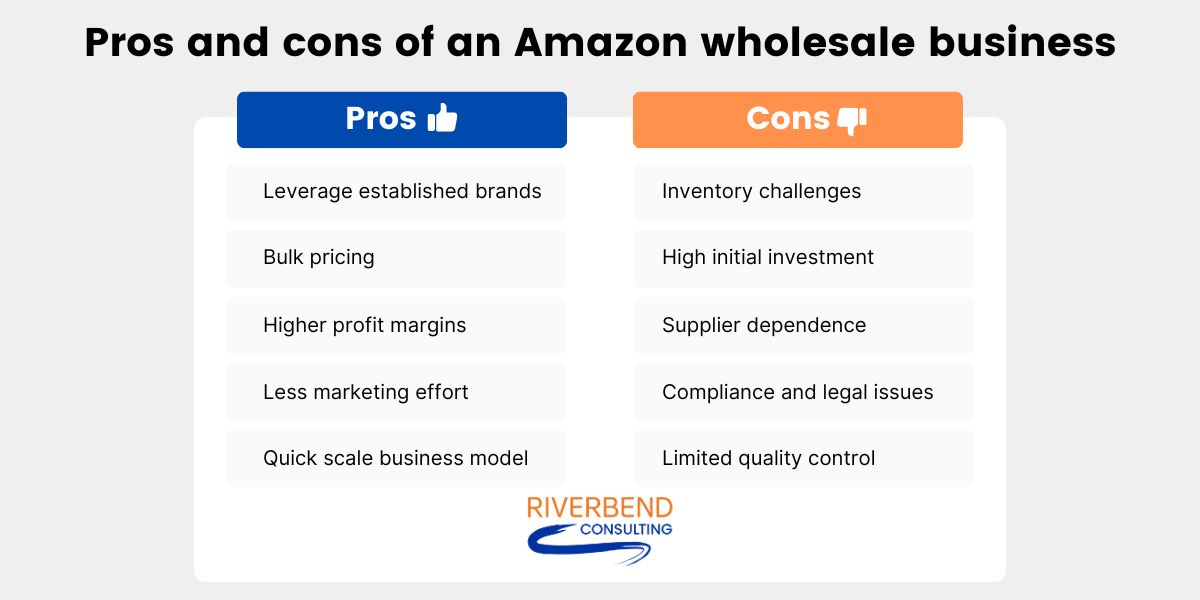
While there are many benefits to starting an Amazon wholesale business, it’s vital to understand the drawbacks. Here are the main challenges you might face:
- High initial investment: Buying products in large quantities requires significant upfront capital. Costs for storage, shipping, and handling add to the initial financial burden
- Inventory management challenges: Managing large inventory demands adequate storage space, which can be costly. Maintaining the correct stock levels to avoid overstocking or stockouts is crucial.
- Competition and price wars: Competitive pricing can reduce profit margins, impacting profitability.
- Supplier dependence: Delays, inconsistent quality, or price changes can disrupt your business. Smaller businesses may need help to secure favorable terms from suppliers.
- Compliance and legal issues: Ensuring compliance with product standards and Amazon’s policies is essential to avoid penalties. Violating Amazon’s strict guidelines can lead to Amazon seller account suspension or bans.
- Market volatility: Changes in market trends can leave you with unsold inventory, while economic shifts can affect consumer buying behavior and sales.
- Complex logistics: Managing packing, shipping, and handling returns can be complicated and time-consuming.
With careful planning and diligent management, you can mitigate these risks and build a successful Amazon wholesale business despite challenges.
Diversification is the key to your Amazon success
Starting an Amazon wholesale business holds great potential for growth and profit, but it comes with its share of challenges. The competitive landscape, high initial investment, and stringent compliance requirements can make it daunting. Navigating wholesale complexities requires resilience and strategic planning.
Meeting the essential requirements—registering your business, securing a resale certificate, and obtaining an EIN—lays the groundwork for entering the wholesale market. Try Amazon wholesale to expand your business and avoid the pitfalls of a single-selling approach.
Seller Account Health. Solved.