
Walmart isn’t trying to beat Amazon at its own game anymore; it’s building a different one. Over the last 18 months, the company has made moves extending beyond market share, acquiring entire brands and pulling them from competitors’ shelves. Investing in fulfillment speeds that rival Prime. Creating tools that make sellers rethink which platform gets their best products.
These aren’t incremental updates. They’re strategic shifts with long-term consequences for anyone selling online. If you’re an e-commerce seller who’s been treating Walmart as a secondary channel, 2025 is the year you risk falling behind.
Walmart’s private-label advantage
Walmart completed its acquisition of Vizio on December 3, 2024, for approximately $2.3 billion to strengthen Walmart Connect with Vizio’s SmartCast OS (Walmart Corporate News and Information). (Some industry reports have speculated about potential impacts on distribution, but Walmart has not confirmed any exclusivity changes.)
On paper, it was a move into the consumer electronics sector. In practice, it demonstrates exclusivity.
Starting in 2025, Walmart is reportedly prioritizing Vizio within its ecosystem. This gives Walmart control over pricing, promotion, and product evolution. It also sends a clear message. In specific categories, the company is willing to close the door to competitors entirely, including Amazon.
For sellers, it’s a reminder that marketplaces are no longer neutral shelves. They are curated ecosystems that are shaped by the platform’s ownership of product lines.
Marketplace growth: Seller incentives
Walmart’s Marketplace is gaining serious momentum. By mid-2025, industry trackers estimated Walmart Marketplace had surpassed 200,000 active sellers, with roughly 44,000 new merchants joining in the first five months alone. While Walmart does not publish official seller or listing counts in Seller Center, the company has reported consistent double-digit year-over-year growth in marketplace GMV and assortment, with the vast majority of products now supplied by third-party sellers.
Walmart now lists more than 500 million items online. Independent analyses suggest the vast majority are from marketplace sellers (Axios). In Q4 FY25, the U.S. Marketplace grew 34 percent. Walmart Connect advertising revenue grew 24 percent. U.S. e-commerce grew roughly 20 percent (Walmart Corporate).
But growth is only part of the story. Walmart is layering on seller-facing incentives, designed to accelerate onboarding, improve profitability, and smooth operational friction.
- New-seller savings: For sellers launching after February 1, 2025, Walmart offers 30% off the first $50K in GMV and 75% off from $50K to $750K, plus up to $2,000 in Walmart Fulfillment Services (WFS) credits and $1,000 in Walmart Connect ad credits.
- Pro seller program: A tiered rewards program (Rising, Advanced, Pro) that unlocks 5–10% referral fee discounts, ad credits, faster payouts, funding options, and Ship with Walmart shipping discounts for sellers who maintain strong performance metrics (Walmart Marketplace).
- Holiday & seasonal incentives: In past years, Walmart has offered seasonal fee adjustments, such as waiving peak-season storage fees for Walmart Fulfillment Services (WFS) items during the holiday period.
- Faster payouts via JPMorgan partnership: A 2025 partnership with JPMorgan Chase enables quicker disbursement of seller funds, improving cash flow and allowing sellers to reinvest more quickly.
- Marketplace capital & credits: Walmart supports small sellers through capital and credits, including incentives for new sellers, to help them scale their business on the marketplace.
- Expanded logistics Support: Walmart now offers multichannel solutions through its Walmart Fulfillment Services (WFS) network, allowing you to fulfill orders from your website and other marketplaces in plain, unbranded packaging.
Growth alone doesn’t explain Walmart’s pull. Behind the expansion lies strategic infrastructure upgrades that make the platform more attractive to sellers, like the partnership with JPMorgan Chase to accelerate seller payouts.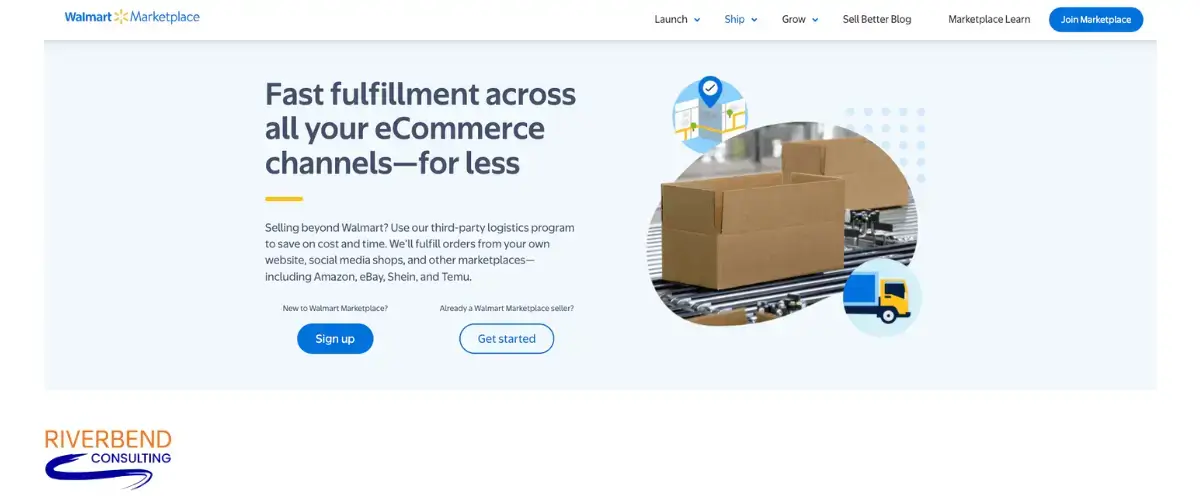
This move addresses one of the most persistent challenges for sellers: access to working capital during inventory-heavy periods. Faster payments enable sellers to reinvest quickly, replenish stock and remain competitive amid surging demand.
These incentives work in tandem with Walmart’s marketplace expansion, creating a rapidly growing environment that actively lowers barriers for sellers seeking to establish a competitive foothold.
Technology and fulfillment shaping Walmart’s seller strategy
Walmart’s seller strategy is centered on one key goal: helping sellers better serve Walmart’s customers. The company’s 4,600 U.S. Supercenters now double as same-day distribution hubs, supported by a growing network of automated fulfillment centers. This hybrid model allows Walmart to shorten delivery windows and expand same-day coverage to millions of households, narrowing the gap with Amazon Prime.
On the technology side, Walmart Connect, the company’s retail media arm, continues to expand its reach. AI-powered tools, like “Sparky” virtual assistant and “Super Agents,” are designed to enhance targeting, streamline seller operations, and provide shoppers with a more personalized experience. Walmart’s long-term outlook underscores the growing significance of e-commerce in its overall business. In its 2025 Investment Community Meeting prepared remarks, Walmart stated that e-commerce is now approaching about 20% of total sales and is expected to drive roughly 50% of the company’s topline growth over the next five years.
For sellers, these advancements mean more than faster shipping. They signal a marketplace where customer expectations will continue to rise and where operational excellence, advertising strategy, and product visibility will directly impact success.
Walmart risks and realities: What to consider
For all the opportunities Walmart is creating, it’s not a frictionless marketplace. Sellers who focus solely on incentives without preparing for the operational differences often find themselves blindsided. Here’s what you need to know before you commit resources.
- Compliance standards vary and are stricter in some areas: Your Walmart Marketplace strategy must be prepared for stricter compliance standards to avoid penalties or suspension. Walmart’s current baseline standards: Cancellation Rate under 2 percent, On-Time Delivery over 90 percent, Valid Tracking Rate over 99 percent (Walmart Marketplace Learn). Every item must have a verified product identifier, such as a GTIN, UPC, EAN, ISBN, or Walmart-assigned Product ID, unless you’ve been granted a GTIN exemption.
Related Content: Walmart Account Deactivated? Learn How to Reinstate
- The Buy Box is more price-sensitive: Walmart’s algorithm heavily favors competitive pricing and shipping speed is a top tie-breaker. Sellers outside of Walmart Fulfillment Services (WFS) often face a disadvantage, especially on high-demand SKUs.
- Geography influences visibility: Walmart prioritizes sellers who can ship quickly to the buyer’s location. If your inventory isn’t distributed to cover key regions, your listings may show less often in search results, even if you meet price requirements.
- Category dynamics can be a double-edged sword: Some categories, like home essentials, consumables, pet products, and value electronics, are primed for growth. Others, particularly branded electronics and beauty tools from non-direct sources, carry a higher risk for IP complaints or “unsuitable goods” suspensions.
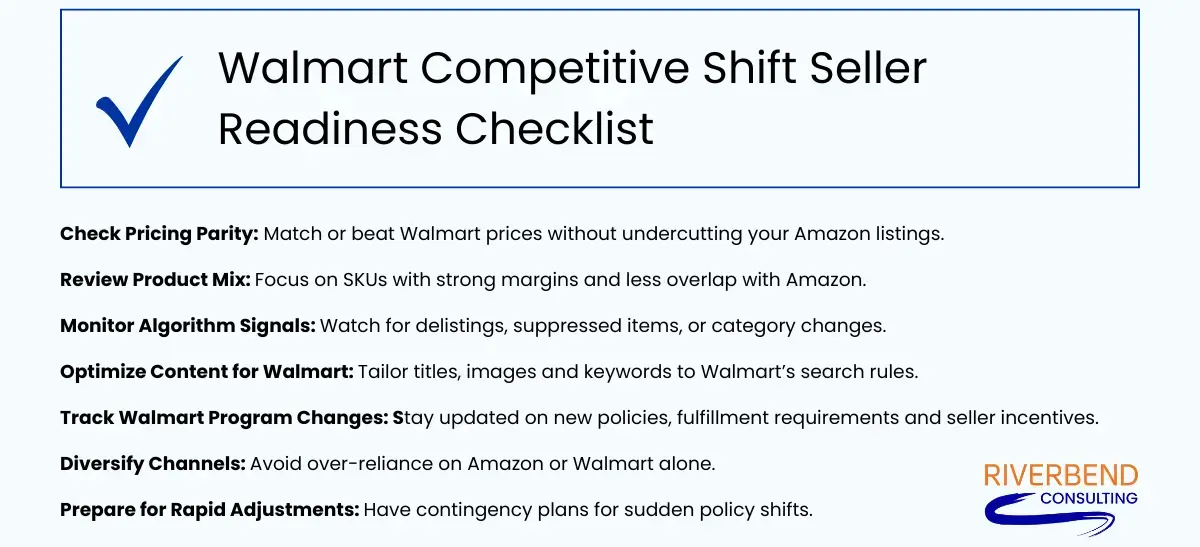
- Cross-listing can create channel conflict: If you’re selling duplicate SKUs on Amazon and Walmart, it’s crucial to monitor your pricing closely. Under Walmart’s 2025 Price Parity and Price Leadership rules, items may be unpublished or removed from the site if Walmart finds them offered for less on another platform, even after factoring in shipping.
A successful Walmart seller strategy requires a dual focus. Take advantage of its seller-friendly incentives and build a compliance-first, operationally efficient foundation from day one.
The Walmart seller strategy shift: What it means for your online growth
Walmart is changing the playing field for online sellers, redefining the markets you can enter and the way you compete. Rather than simply expanding product listings or adding new vendors, the company is rewriting the terms of competition.
Success on the platform depends on recognizing how these structural changes affect everything from product eligibility to the speed at which you can reinvest profits. Here are four ways Walmart’s evolving strategy will directly shape seller opportunities and challenges in the months ahead.
- Exclusivity changes the game: Walmart’s willingness to remove competitor access in specific categories can close opportunities for cross-listing.
- Lower barrier to entry: Referral fee discounts, ad credits, and waived storage fees can help reduce upfront costs and improve early-stage margins.
- Faster cash flow fuels growth: Accelerated payouts can offer liquidity to restock and scale more aggressively.
- Technology and fulfillment set the standard: Those who adopt Walmart’s advertising tools and align inventory with fulfillment programs will have a distinct advantage.
How Riverbend Consulting can help
Adapting to Walmart’s rapid transformation isn’t about listing products and waiting for sales. Sellers need a plan to safeguard their accounts, operate efficiently, and make strategic use of Walmart’s programs without stumbling into compliance pitfalls.
That’s where Riverbend Consulting comes in. We’ve spent years solving complex operational problems for Amazon and Walmart sellers. Those skills translate directly to Walmart’s growing marketplace. Here’s how we support your Walmart seller strategy at every stage of growth.
#1 Manage Walmart suspension appeals and enforcement escalations
If your seller account or listings are suspended, we prepare targeted, compliant Walmart appeals to resolve issues quickly and restore your selling privileges.
#2 Resolve enforcement actions and protect selling privileges
We work to quickly address policy violations, documentation requests and account health issues, so you can minimize downtime and avoid costly disruptions.
#3 Recover lost revenue
From misplaced inventory to incorrect payment deductions, our team identifies discrepancies and manages Walmart reimbursement claims to ensure you’re not leaving money on the table.
#4 Strategic readiness for marketplace shifts
Whether Walmart rolls out new seller incentives, policy changes, or exclusive product initiatives, we help you adjust your operations and stay competitive without having to scramble.
Whether you’re expanding into Walmart for the first time or already have an established presence, our goal is the same. Protect your account, strengthen your operations and position yourself to take full advantage of Walmart seller opportunities in 2025 and beyond.
Now is the time to act on Walmart
Your Walmart seller strategy must be about more than competing with Amazon. It’s about building a marketplace that blends scale, exclusivity and technology to create a distinct competitive advantage. For sellers, the choice is no longer whether to take Walmart seriously; it’s how to position yourself to succeed there. Those who act early and adapt to Walmart’s strengths will be best equipped to capture growth in the years ahead.
Suppose you’re facing a Walmart suspension or denied appeal, speed matters. At Riverbend, we’ve turned high-stakes Walmart cases into seller wins by knowing exactly how to work their process. Contact us today and let’s get your account back in the game.
Seller Account Health. Solved.
FAQs
Q: How is the Walmart seller strategy changing the e-commerce landscape?
A: Walmart is redefining competition by controlling product availability, pricing power, and marketplace access.
Q: What does Walmart’s private-label focus mean for other sellers?
A: It creates more competition for shelf space and forces sellers to offer unique value.
Q: Why is the Walmart seller strategy important for online merchants?
A: It impacts where and how sellers can compete, especially in high-demand categories.
Q: How can e-commerce sellers adapt to Walmart’s changes?
A: Focus on differentiation, pricing agility, and diversifying sales channels.
Q: Does this shift affect small and mid-size sellers differently?
A: Yes. Smaller brands may face higher barriers to entry without a strong brand identity.