Getting pricing right on the Walmart Marketplace is vital to protecting your business. Walmart has invested heavily in automated systems to scan, compare, and enforce fair pricing across its platform. The intention makes sense. Walmart’s promise to shoppers is an “Everyday Low Price” (EDLP). The company expects sellers to uphold that brand promise.
But the challenge is that Walmart pricing rules are strict, often unforgiving, and can result in unpublished listings or even Walmart account suspensions if ignored. That’s why mastering Walmart pricing rules is one of the most essential skills for Marketplace success in 2025. In this article, we’ll walk through what you need to know, how the rules work, strategies to stay ahead, and how Riverbend Consulting can help you if pricing issues put your account at risk.
What you need to know about Walmart pricing rules
When you sell on Walmart, your pricing isn’t judged in isolation. The system compares your item’s price, including shipping, against the marketplace average, historical pricing, and prices on competing online sites. If your item appears too expensive, or if your shipping charges seem unreasonable, Walmart’s automation may pull your listing without warning. This is known as being “unpublished for pricing,” and it’s one of the most common issues Walmart sellers face.
Walmart also emphasizes consistency. If one of your SKUs is drastically higher on Walmart than it is on Amazon or your own website, the Walmart algorithm sees that as unfair. The result is often removal from search visibility until the corrections are made. While frustrating, the rules exist to keep Walmart competitive with Amazon, Target, and other online marketplaces. Sellers who ignore these dynamics risk losing sales, damaging their account health, and in extreme cases, facing suspension for repeated violations.
Walmart pricing rules aren’t a set-and-forget part of your business. They require monitoring, adjustment and alignment with Walmart’s internal reference pricing benchmarks.
Walmart’s pricing policy explained
Walmart’s pricing policy is written in plain terms. If your price is egregiously higher than what customers expect, or your shipping cost makes the total uncompetitive, your item can be unpublished. These enforcement measures are designed to protect Walmart’s Every Day Low Price (EDLP) promise, ensuring that sellers consistently deliver fair and competitive offers in line with the brand’s reputation.
A common flag you’ll see is “Reasonable Price Not Satisfied.” This means that your total offer price (item + shipping) is outside the acceptable range compared to Walmart’s reference data. Another common flag is titled “Egregious Shipping Cost.” Even if your product price is fine, a padded shipping fee can get you into trouble. Walmart wants the final cost to the customer to reflect fairness and transparency.
What makes this tricky is that the system is proactive. You may not realize you’re out of alignment until the item disappears from search. Fortunately, Walmart provides some guidance. You can view unpublished listings in your Seller Center dashboard, along with the corresponding reason code.
Once your item’s price falls back within Walmart’s accepted range, the system usually republishes your listing within 48 hours. This applies not only to items flagged as overpriced with the ‘Reasonable Price Not Satisfied’ notice, but also to offers marked as underpriced with the ‘Pricing Error’ reason code. In both cases, you can use the Unpublished Items dashboard to view Walmart’s reference price and adjust your catalog accordingly.
Walmart isn’t out to punish you. It’s protecting its brand reputation. Repeated or blatant violations can escalate beyond simple item removals. Understanding Walmart pricing rules is vital to maintaining long-term account health.
Master Walmart pricing rules with these strategy tips
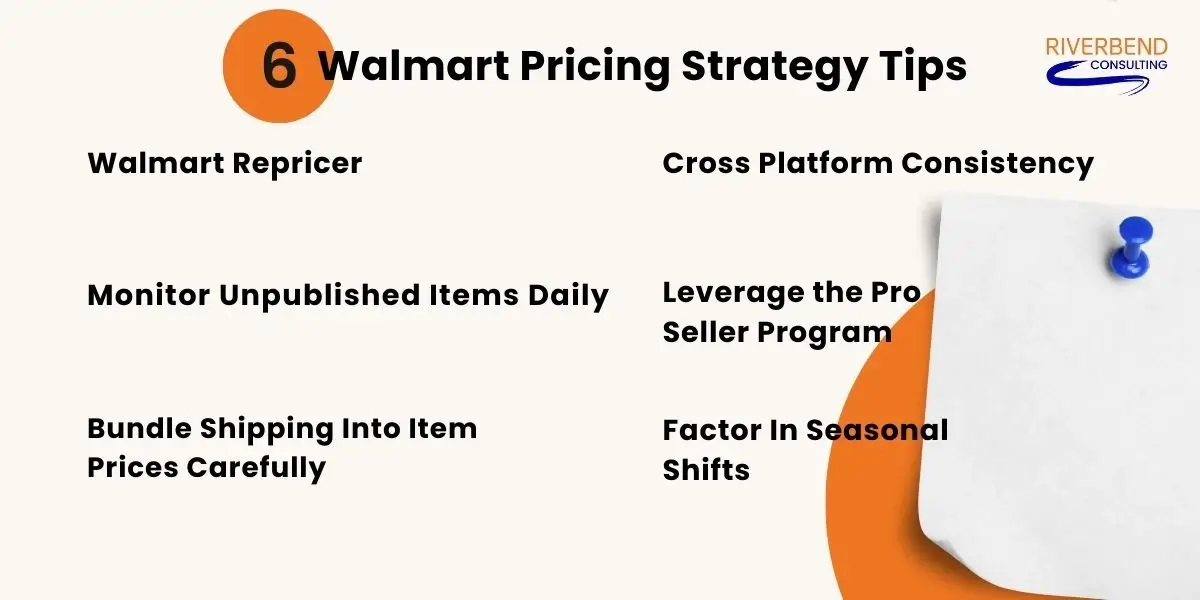
Competitive pricing strategy optimization at Walmart means staying competitive while protecting your margins. Here are several actionable approaches to help build into your Walmart strategy:
Use Walmart’s repricer tool
This automation adjusts your prices in real-time to match or beat those of your competitors. It helps you stay in the Buy Box without manually adjusting prices daily.
Monitor unpublished items daily
One of the fastest ways to avoid pricing problems snowballing is by keeping a close eye on your unpublished items dashboard inside Walmart Seller Center. Here’s how you can stay on top of it:
- Log in to Seller Center and head to the Growth Opportunities tab or Manage Items (depending on your dashboard layout).
- Look for the “Unpublished” or “Suppressed” filter in your catalog view. This filter shows every SKU that Walmart has hidden from search.
- Each unpublished item will include a reason code. For pricing, you’ll usually see “Reasonable Price Not Satisfied” or “Egregious Shipping Cost.”
- Download the report (a CSV option is available) to quickly sort and prioritize which SKUs require attention.
- Update your pricing or shipping fee directly in Seller Center or via your feed integration. Make sure your adjustments align with Walmart’s reference pricing range.
- After saving your changes, monitor the item’s status. Most listings that are corrected republish within 48 hours.
- If a listing does not republish after that window, open a case with Partner Support and provide documentation (e.g., competitor screenshots, cost structure, or proof of correction).
A simple 5-minute check every morning can help prevent issues before they grow.
Bundle shipping into your item price carefully
Many sellers roll shipping into their product cost and advertise “free shipping,” but if that bundled price pushes your total offer outside Walmart’s reference range, the algorithm can still flag you. Check your delivered price (item + shipping) against Walmart’s benchmarks before updating your catalog.
Leverage the Pro Seller Program
Walmart’s Pro Seller Program ties your pricing strategy to your account benefits. The program uses your price competitiveness score to determine tier placement and each level brings greater rewards. Sellers in the Rising and Advanced tiers receive perks like faster payouts, shipping discounts, and increased visibility. Those in the Pro Seller tier can unlock referral fee discounts of up to 10%, along with ad credits and additional growth tools.
To qualify, you must maintain at least 65% for Rising Seller, 70% for Advanced Seller, and 75% for the Pro tier. This makes competitive pricing more than a survival tactic. It’s a way to unlock cost savings and higher visibility. Dropping below these thresholds doesn’t just reduce your benefits; it signals that your pricing needs adjustment before it impacts your account health.
Keep an eye on cross-platform consistency
If you sell on Amazon, Shopify, or eBay, ensure your Walmart pricing is not significantly higher. Walmart’s algorithm pulls external data, meaning inconsistencies can harm you.
Factor in seasonal shifts
Holiday surges or supply chain issues may tempt you to raise prices. Walmart watches for gouging, especially during high-demand seasons. If you need to increase prices, do it gradually and within reason.
Your Walmart pricing strategy must strike a balance between competitiveness and compliance. Price is too high and you risk a Walmart account suspension. Price too low and you can erode your margins.
Repricing on Walmart: What you need to know
Manually tracking your dashboard and tweaking prices for each SKU can drain hours of your day. That’s why automation is such a powerful tool for maintaining competitive pricing without burning out. Walmart’s native repricer and third-party software solutions promise to keep your prices competitive without breaking policy, but each comes with its own strengths, limitations, and risks.
Walmart’s built-in repricer is free and can be activated directly in Seller Center. Walmart’s native repricer automatically adjusts your item price based on the strategy you select, such as matching or beating competitors. Walmart does not publish an exact update timeframe for when changes take effect. Note: The tool is designed to focus on item prices rather than shipping settings.
Outside repricers can scrape real-time data, build complex rules, and let you set floor and ceiling limits to help protect your margins. Some repricers incorporate cost tracking to prevent you from accidentally selling below your break-even point. The downside? Not all third-party tools are equal. Some rely on Walmart’s API, which can lag, while others may complicate your strategy. Choosing a trusted provider is crucial if you opt for this route.
Repricing should help you compete, but if left unchecked, it can backfire. Too many sellers set rules that simply undercut the lowest competitor. This creates a race to the bottom, slashing profits and, in some cases, causing price parity problems if your Walmart listings end up lower than those on your other channels.
Whether using Walmart’s repricer or an external solution, set rules that prevent your offer from dropping below cost plus a comfortable margin. If competitors dip below that threshold, your listing can hold steady instead of spiraling down. This way, you can stay competitive without sacrificing profitability or risking account health.
Repricing tools can be a powerful ally when used wisely. They help you react to competitor changes faster than manual monitoring ever could, but they work best as part of a larger strategy, not as a replacement.
Walmart seller suspension prevention and pricing
The stakes increase if pricing violations occur repeatedly. While Walmart typically unpublishes non-compliant items first, chronic issues can escalate into a Walmart account suspension. A few unpublished listings may seem harmless, but if the system flags you repeatedly, Walmart views it as non-compliance with its Retailer Agreement.
To avoid suspension, adopt a proactive defense strategy:
- Respond immediately to unpublished items. Correct your prices and confirm whether the listings republish within 48 hours.
- Track your metrics. Walmart’s Account Health dashboard reflects price competitiveness in relation to the Pro Seller program, so staying above the threshold is critical.
- Document your corrective actions. If you ever need to appeal, proof that you made prompt and consistent fixes strengthens your case.
- Don’t ignore customer perception. Even if Walmart doesn’t suspend your account, overpriced listings can generate negative reviews or low seller ratings. Both hurt your Buy Box performance and long-term viability.
Treat Walmart pricing rules as guardrails to build trust with customers. Protecting that trust is the best insurance against account suspension.
How Riverbend Consulting can help with Walmart account suspensions
When your Walmart account is suspended for pricing violations, the stress is immediate. Orders stop, cash flow dries up, and the clock starts ticking against you. Sellers often discover that simply lowering prices isn’t enough. Walmart expects a professional, detailed plan that addresses the root cause and the safeguards you’ll use to prevent future problems. That’s where Riverbend Consulting steps in.
Our process begins with a thorough examination of your case. Every Walmart suspension has its own backstory. We analyze your deactivation notices, past performance, and catalog activity to uncover what triggered the Walmart pricing rule and issue. From there, our consultants build an appeal plan that does more than apologize; it demonstrates to Walmart that you’ve identified the problem, implemented controls, and are prepared to meet marketplace standards going forward.
Walmart account reinstatement is often not achieved with a single attempt. Walmart’s internal teams may push back or ask for additional details. Riverbend’s advantage is persistence. We know the process. We don’t stop after the first response. Our team works every possible angle until your Walmart account is back online.
With Riverbend, you’re not facing Walmart alone. You gain advocates who understand the marketplace inside and out and who know how to present your case in a way that gets results.
Stay safe and steady with Walmart Marketplace compliance
Your Walmart pricing strategy is a cornerstone of trust between you, Walmart, and the customer. By understanding the Pricing Rule, monitoring your listings, using tools like the repricer, and maintaining competitive yet fair offers, you can thrive on the platform without fear of sudden interruptions.
When issues arise, the key is to make fast corrections and maintain clear communication. Document your fixes, watch your metrics, and treat Walmart’s pricing rules as a framework for long-term success, not a punishment.
If you need guidance or face a pricing suspension, Riverbend Consulting is here to help. With the right strategies and support, you can maintain a healthy Walmart account and grow your business on the marketplace.
Seller Account Health. Solved.
FAQ
Q: What are Walmart’s pricing rules for Marketplace sellers?
A: Walmart enforces automated pricing rules that unpublish offers that are “egregiously higher” than prices on Walmart.com or competing sites, including shipping costs.
Q: Why does Walmart enforce strict pricing rules for its Marketplace sellers?
A: To protect customers from unfair pricing, preserve trust in its Everyday Low Price (EDLP) commitment and keep its marketplace competitive.
Q: How do Walmart’s pricing rules compare to those of other online marketplaces?
A: Walmart’s policies are stricter about price parity, shipping costs, and price leadership than many competitors. Violations can lead to automatic unpublishing.
Q: How can I ensure my pricing strategy aligns with Walmart’s Every Day Low Price (EDLP) commitment?
A: Regularly monitor both your item price + shipping against Walmart.com and competitors’ prices, use repricers, and avoid pricing that looks like price gouging.
Q: What is the Price Parity rule on Walmart Marketplace?
A: Price Parity requires that your total price (item cost + shipping) on Walmart not be higher than on external sites or other marketplaces.
Q: How does the Price Leadership rule affect my product listings on Walmart?
A: If your listing is significantly undercut by competitors, Walmart may demote it (e.g., remove Add to Cart/Buy Box eligibility) or suppress it in search visibility.
Q: What should I do if my product is unpublished due to a pricing violation on Walmart?
A: Review the “Reasonable Price Not Satisfied” reason and adjust your pricing to match or undercut the reference price (including shipping). Walmart often republishes the offer once compliance is restored.
Q: Can high shipping costs lead to a product being unpublished on Walmart?
A: Yes. High shipping fees (relative to item price) can trigger the Egregious Shipping Cost rule and cause automatic unpublishing.
Q: What is considered an egregious shipping cost violation at Walmart?
A: Shipping costs that make the total (item + shipping) far less competitive compared to other offers or external benchmarks; exact thresholds are not public and context-dependent.
Q: How can I monitor my pricing to avoid unintentional violations on Walmart?
A: Use Walmart’s Unpublished Items dashboard, regularly compare your listed prices + shipping with competitors, set up repricer tools or solutions, and keep shipping templates updated.