What’s worse than a suspended Amazon seller account and suspended ASINs? How about Amazon gating you out of your most important brands – even your own private label brands.
We’ve noticed a disturbing trend among both new and long-term clients at Riverbend Consulting. After selling specific brands for years – or even a decade – Amazon has gated high-quality sellers out of these valuable brands. The seller then applies for ungating time and again, only to be denied. This can occur even when suppliers and invoices are top-notch. The next step is a series of executive escalations, which are time-consuming and thus far have mixed results.
After extensive investigation into these cases and the trends we have seen, we’ve found a similar factor in most: the seller failed to appeal suspended ASINs within the brands in question for inauthentic, condition and other product quality defects.
It appears that Amazon is connecting some dots, fairly or unfairly. They may be assuming that the seller did not appeal for lack of invoices, or because their product quality was, in fact, faulty. If a seller does not work to get suspended ASINs reinstated, Amazon is drawing the conclusion that the seller cannot be trusted with that brand.
Why would a seller fail to appeal an ASIN of a brand they value? Well, it might just be the result of Amazon’s own policies.
A seller’s Account Health Rating can be misleading
With the introduction of the Account Health Rating (AHR) in fall 2022, Amazon tried to reassure sellers that their accounts would not be suspended out of the blue. Rather, if sellers simply paid attention to their Account Health Rating, they should be just fine!
The AHR is represented graphically by a horizontal bar, which ranges from 0 points to 1000 points:
- 0-100 points is “red” and “unhealthy,” and the account is either suspended or eligible for suspension.
- 100-199 points is “yellow” and “at risk,” and the account is at risk of deactivation.
- 200 points and above is “green” and “healthy,” so the account is not at risk of deactivation.
So, it makes sense that the average seller would glance at their AHR and make some decisions. If their rating is green, they may choose to ignore any suspended ASINs or policy violations for now.
Unfortunately, this has become a risky proposition. In short, the AHR cannot be trusted:
- We have seen sellers suspended when their AHR was in the green – with no warning.
- We have seen sellers gated out of important brands when their AHR was in the green – with no warning.
- We have seen sellers go from an AHR of 1000 to 0 overnight – based on a single violation.
A new way of viewing your AHR
So, while Amazon may have intended the AHR system to provide sellers with some semblance of confidence in their account remaining active, it is not always reliable. A selling account can still be suspended and go from green to red, if Seller Performance so chooses.
On a similar note, Amazon marks account defects with a label that is supposed to indicate its level of seriousness. It might be a “critical” defect, a “no impact” defect, or even a “repeat” defect. In some cases, that label is accurate. But based on Riverbend’s experiences with clients, the label should not be taken as gospel. Just because a defect is labeled as “no impact” or “low impact” doesn’t mean it can’t result in a warning, account suspension or gating. Amazon’s processes are still a black box – despite its insistence that Seller Performance is trying to be more transparent.
So, what should a seller do? How do you manage the impacts without going too far down the rabbit hole and wasting valuable time? This isn’t a one-size-fits-all answer because every seller’s business is different. But there are some best practices with impacts and defects that might help. Ask yourself:
- Is this defect legitimate, even a little? Do your research and determine if there are buyer complaints of returns that indicate a problem you have the power to fix.
- If you think you’re at fault for the defect, acknowledge it – but do the work to prevent recurrences. Amazon will expect that of you, and it saves you pain down the road.
- Is this a big seller at the ASIN level, or an important brand, or both? If not, then it might be better to acknowledge or to appeal – but if you choose the former, it might impact you later. Don’t acknowledge unless you’re sure.
My account got gated out of a brand – now what?
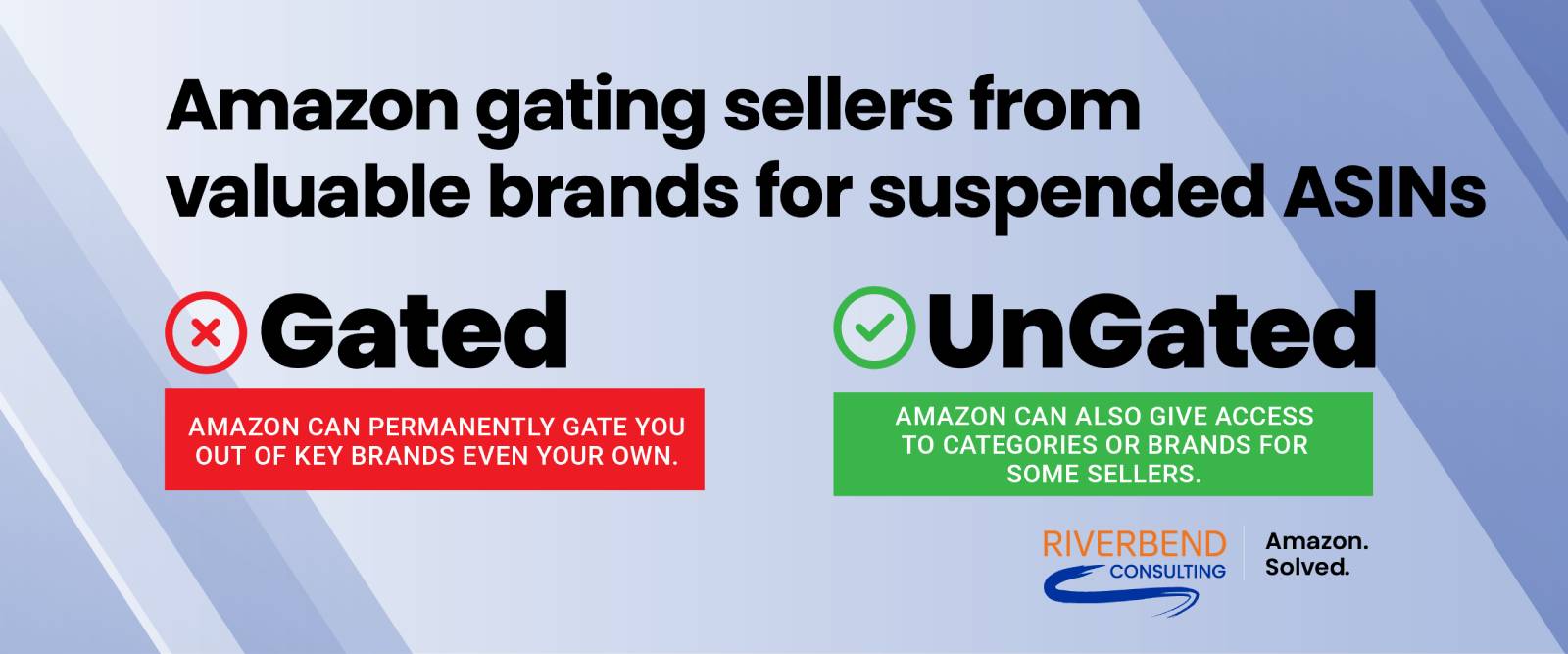
Amazon has the ability to “ungate” (aka give access to) categories or brands for some sellers, and “gate out” (aka restrict) other sellers.
Like the Buy Box and other proprietary Amazon processes, the criteria for gating and ungating remain somewhat mysterious. In some cases, Amazon seems to only be looking for legitimate invoices from a high-quality supplier. In other cases, Amazon is more deeply concerned about the individual seller’s metrics, product quality and overall track record.
If a seller is gated out of a brand, they can usually re-apply. If you’re a reseller:
- Do you have places in Seller Central to apply to the brand? If you’re a reseller and they’re asking you to apply and you haven’t done that before appealing, fill out the applications.
- Review your invoices. Sometimes, invoices do not fit Amazon’s very exacting rules and criteria. Make sure your company information is consistent with what is in your Amazon seller account. Ensure that the vendor’s information is complete and includes full contact information and website. And above all else, make sure your invoice is original and has not been edited by you or your team.
- Check with your supplier. Amazon uses a wide range of methods to determine whether they trust your supplier to provide you with legitimate goods. Does their address make sense? Are they buying directly from the brand? Can they provide you with a Letter of Authorization?
- Look at your Seller Performance dashboard. Do you have defects for ASINs in this brand? How many suspended ASINs are there? If so, appeal them. You must get them successfully appealed before you can hope for ungating – and even then, you may not get an automatic yes.
- Make a case for you to be ungated. If you’re a reseller and you have an excellent track record with this brand, and have sold it for months or years, this shows your worth to Amazon. Emphasize that tenure with the brand.
- Do you have a relationship with the brand? Many times, brands will be willing to write a letter on their letterhead vouching for you and your good relationship. Ask for help!
What about sellers with their own brands?
It’s unbelievable we even have to talk about brands losing access to their hard work and effort, but it can happen. Sometimes, a seller is gated out of their own private-label brands and products. Because gating is such a complex and mysterious process, this can be really unnerving to experience. So, what to do? Try the following:
- Don’t panic. If you’ve gotten any communication about the action, respond to that stating this brand is yours, and you’re happy to provide proof.
- Collect everything. Gather up your trademark registration and any documents or email copies showing you registered your brand with Amazon Brand Registry, as well as any state or federal organizations.
- Add some extras. If you contract to manufacture your materials, invoices, and proof of payment can go a long way towards reversing this decision.
- Make a call. Contact Amazon’s Account Health Services and ask for advice on whom to contact. Tell them your brand’s stats and that you can’t believe you’ve been removed from your own intellectual property.
None of this is working- now what?!
This is a really frustrating experience, and it is probably time to call in a professional to help you address this nightmare. Getting the right facts, figures, and narrative in front of Amazon is key – and sometimes it’s really difficult to do, let alone do well. Let Riverbend walk you through everything, be is a suspended account or suspended ASINs. We can help you present a clear, cogent appeal to Amazon that restores your access to brands and resume selling.
When you need help, Riverbend is there for you. Contact us.
Seller Account Health. Solved.