Amazon sellers know that compliance requirements are never static. Policies shift without much warning. Staying ahead of the curve can mean the difference between keeping your catalog live or watching profitable listings vanish overnight.
In July 2025, Amazon announced a sweeping update that directly impacts product testing across the marketplace. Compliance reports are now only accepted from labs that meet Amazon’s internal safety standards. Sellers must now cross-check the Suspended Validation Labs list and rely on reputable providers in the Service Provider Network before submitting documentation.
For some categories, Amazon has gone even further. In toys and children’s products, sellers face an additional enforcement layer starting September 3rd, 2025, requiring annual testing or verification through compliant Testing, Inspection and Certification (TIC) providers. That means stricter oversight and more documentation responsibilities for those selling into this highly regulated space.
What makes these updates especially important is the message behind them. Amazon is no longer satisfied with a simple pass/fail test. It wants proof that the lab or provider itself can be trusted. That subtle but significant shift changes how sellers must think about compliance, brand defensibility and long-term growth on the platform.
Why Amazon is tightening lab requirements
For years, sellers often treated compliance as a checkbox exercise. Submit a test report, clear the hurdle and move on to the next launch. But Amazon’s new stance suggests that those days are over. By placing more weight on the credibility of testing providers, Amazon is signaling that compliance is about trust and risk management, not just paperwork. A lab with questionable standards puts Amazon at risk of listing unsafe or misrepresented products; that’s a liability the company is no longer willing to accept.
This shift is also about protecting consumers. Amazon faces scrutiny from regulators, media and competitors regarding counterfeit and unsafe products. By tightening lab requirements, they’re attempting to create a stronger safety net for shoppers, while weeding out sellers who cut corners. Compliance is now a proxy for seller integrity. Your choice of lab affects how Amazon evaluates your brand’s credibility.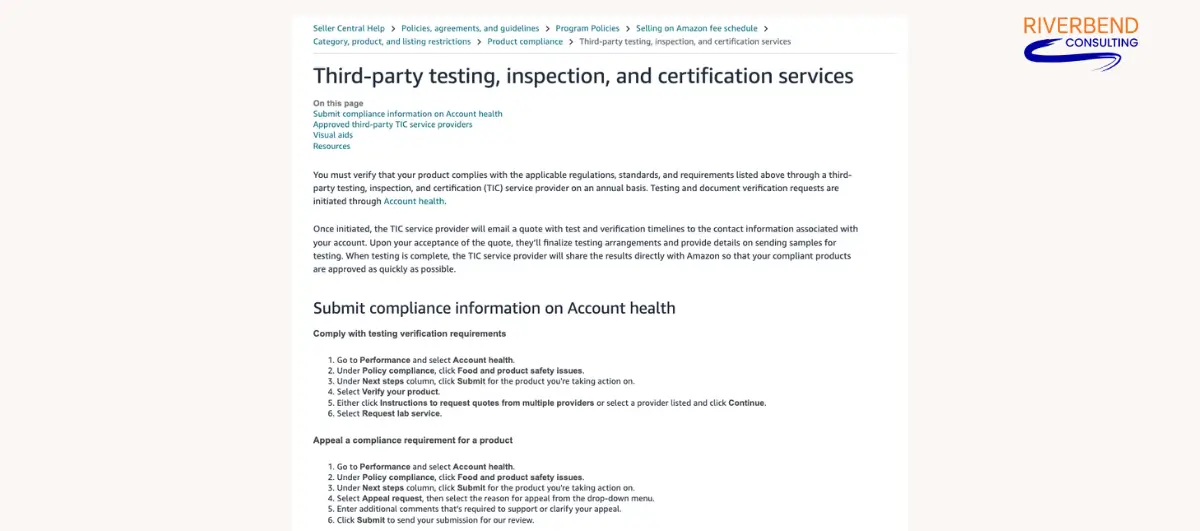
Operational impact of the lab compliance update for sellers
The practical fallout of Amazon’s compliance changes is significant. For all categories, relying on documentation from suspended labs can lead to immediate listing rejections, even if the paperwork was previously accepted. In many cases, Amazon may request resubmissions, delaying new ASIN approvals or causing temporary suppression of existing listings. For brands with large catalogs, this creates a compliance bottleneck that can slow momentum, interrupt sales and add operational strain.
In the toys and children’s products category, sellers must align with the July 13 compliant lab rules and incorporate recurring TIC testing into their workflows. Doing so can add cost, time and logistical pressure, especially for businesses managing seasonal launches or wide assortments of SKUs. Read more below for
Compliance gaps can surface in Amazon’s system as product safety violations or documentation requests, both of which directly affect Account Health. A flagged report can trigger manual reviews, increased scrutiny, and even restricted category eligibility. Sellers who cut corners will find themselves dealing with mounting compliance escalations.
Lab compliance steps you should take now
The best defense against compliance issues is preparation. You must act quickly to audit existing documentation and ensure all reports are issued by labs that remain in good standing with Amazon. This means pulling a full compliance record, checking reports against the suspended lab list and making a plan for resubmission where necessary. Proactive auditing can prevent the shock of sudden listing suppression or delayed approvals.
Next, you should only commission new testing through labs found in Amazon’s Service Provider Network and cross-reference with the suspended lab list before paying for services. Be cautious of providers offering “fast and cheap” solutions, as they may not meet Amazon’s new standards. Finally, communicate these changes to your suppliers and factories, since many sourcing partners still default to local labs that may no longer qualify. Education across your supply chain is essential to staying compliant under this updated policy.
How to find compliant testing providers in Amazon Seller Central

Amazon doesn’t exactly make compliance easy. When you’re juggling sourcing, logistics and account health, tracking down compliance labs can feel overwhelming.
The good news is that Amazon has centralized this information through its Service Provider Network (SPN) and Compliance Portal. Log into Seller Central and navigate to the Service Provider Network. Here you’ll see a directory of testing providers that Amazon currently accepts for compliance documentation. Cross-reference those providers against the Suspended Validation Lab List in the Compliance Portal to ensure your lab isn’t on the “do not use” list.
Always double-check before commissioning new tests and save screenshots or PDF exports to document your due diligence. If Amazon ever questions your choice of lab, being able to show proof that the provider was compliant at the time of testing can save you valuable time in appeals.
Extra steps for toys and children’s products
If you sell toys or other children’s products, your compliance responsibilities go beyond the standard rules. By U.S. law, every children’s product must be backed by a Children’s Product Certificate (CPC) based on testing from a CPSC-accepted laboratory. This applies whether you’re selling toys, apparel, or any item intended for children under 12.
Where this gets more complex is how that legal requirement intersects with Amazon’s own changes. As of July 2025, Amazon only accepts compliance reports from labs that meet its internal safety standards. It maintains a Suspended Validation Labs list that you must avoid.
For the toys category specifically, starting Sept 3, 2025, you must complete annual testing or document verification through a compliant Testing, Inspection and Certification (TIC) provider.
In practice, you need to satisfy both sets of checks. First, confirm your provider is not on Amazon’s Suspended Validation Labs list. Next, select a reputable option via the Service Provider Network. Finally, ensure the lab is CPSC-accepted to ensure your CPC complies with U.S. law, and, for toys, plan for the annual TIC testing/verification Amazon requires starting from September 3. Skipping any step can lead to rejected documentation, suppressed listings, or Account Health actions.Build these checks into your launch and renewal cadence to protect your brand, your customers and the defensibility of your account.
How toy brands can prepare for TIC enforcement
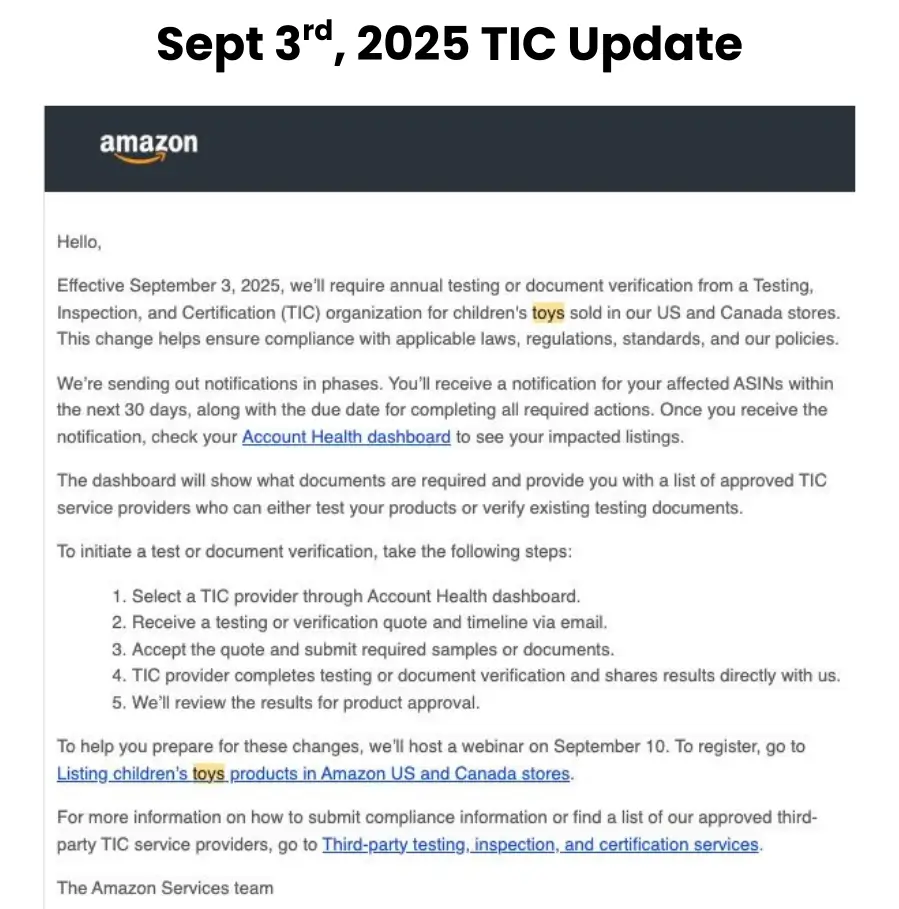
For toy and children’s product sellers, the September 3 TIC enforcement means compliance can’t be left to chance. Annual testing and document verification will become part of the cost of doing business on Amazon. The brands that get ahead now will avoid last-minute panic and costly delays later. Here’s what you can do to prepare:
- Audit your current compliance records: Pull every Children’s Product Certificate (CPC) and confirm it was issued by a CPSC-accepted lab. If not, schedule retesting immediately.
- Identify an approved TIC provider now: Don’t wait until September to find one. Use Amazon’s Service Provider Network to lock in a provider early and prevent bottlenecks when every seller is scrambling.
- Build TIC testing into your calendar: Treat compliance like inventory forecasting. Annual TIC verification should be scheduled just like product launches or Q4 promotions.
- Document everything: Don’t just upload certificates. Keep a compliance archive with lab contacts, testing protocols and receipts. If you’re flagged in a manual review, being able to demonstrate a full paper trail accelerates resolution.
- Integrate TIC costs into product pricing and margin models: Many toy brands forget that annual testing is now a fixed cost. If you don’t account for it in your P&L, margins erode fast. Build testing into landed cost models so you’re not blindsided at scale.
- Consolidate SKUs before testing: Every variation (color, size, minor feature) may require its own compliance review. Too many toy brands keep bloated catalogs alive. Consolidating SKUs now reduces the amount of testing you’ll have to pay for annually.
- Align compliance cycles with each quarter: Don’t wait until September each year to test. Tie your TIC testing to your product launch or Q1 planning cycle, so it doesn’t collide with Q4 demand when every day of downtime costs you sales.
- Negotiate testing agreements directly with TIC providers: Most sellers treat TIC as a one-off transaction. Negotiate multi-SKU or multi-year contracts with TIC providers to achieve cost savings and prioritize turnaround.
- Map compliance to your supplier contracts: Update agreements with factories to ensure they work only with CPSC-accepted labs and support the TIC process. This reduces back-and-forth when Amazon asks for resubmission.
Toy brands that treat TIC requirements as infrastructure, not red tape, will be in the best position to grow on Amazon. Compliance may feel like a hurdle, but it’s quickly becoming the foundation of long-term stability.
Moving forward with lab compliance
These compliance updates are a wake-up call. Sellers who continue relying on suspended or non-compliant providers risk rejected documents, delayed approvals and potential account health issues.
For toys and children’s products, the bar is set even higher. The path forward is clear. Build compliance into the core of your operations. By verifying your labs, keeping documentation current and aligning with both Amazon’s and CPSC’s standards, you protect your listings and position your brand for growth, even in restricted or competitive categories.
Need help navigating Amazon’s new lab compliance rules? Riverbend’s Amazon problem solving experts can guide you through verification so your listings stay protected.
Whether you’re dealing with the July 13 enforcement or the September 3 toy requirements, our team can help you avoid account health risks and keep your business moving forward. Schedule a call with Riverbend today to make compliance one less thing to worry about.
Seller Account Health. Solved.
