
DD+7 Amazon payout policy timing has been a moving target for sellers, but concern is mounting with the expanded enforcement of the DD+7 reserve policy, set to take effect across European accounts by September 2025 and U.S. accounts by March 2026.
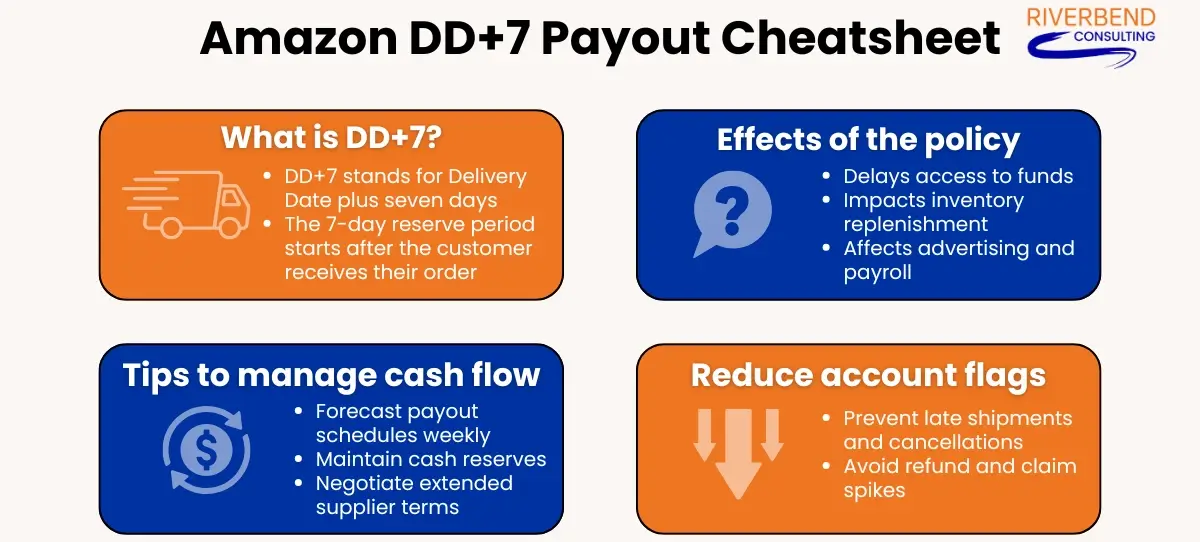
Under DD+7, Amazon holds seller funds for seven days after the customer’s delivery date before releasing them for disbursement. For many third-party sellers, that week-long delay can feel like an eternity when payroll, inventory restocks, an d advertising costs depend on predictable cash flow.
When those payouts shift, even by a few days, lean operations can quickly turn into liquidity crises. The change arrives during one of the harshest financial climates Amazon sellers have faced.
At Riverbend Consulting, we’ve seen compliant sellers pushed to the edge by payout delays they can’t control. The DD+7 transition means learning to manage cash flow, systems, and expectations before the delay turns into a disruption.6
What is the DD+7 Amazon payout policy?
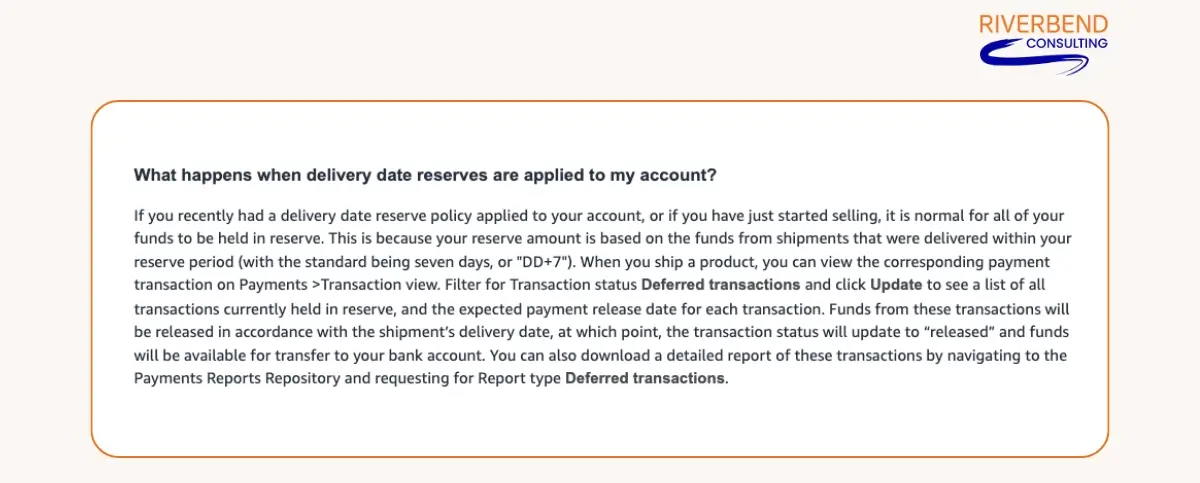
Payout timing on Amazon is tied to the method and timing of order delivery and confirmation. The “DD” in DD+7 stands for “Delivery Date Based Reserve”, meaning Amazon calculates when to release your funds based on when a customer receives their package.

Under Amazon’s delivery date-based reserve (DD+7), funds are withheld until seven calendar days after the confirmed delivery date. After that reserve period ends, the balance becomes eligible for release in the next scheduled disbursement cycle.
At first glance, that may not seem like much, but for high-volume sellers or those relying on consistent cash flow, those seven days can feel like an eternity. It effectively extends Amazon’s control of your operating capital and can create rolling delays that stack across thousands of orders.
The reasoning behind the policy, according to Amazon, is risk mitigation, ensuring buyers have time to report issues or request refunds before sellers receive payment. While this logic protects the customer experience, it can put sellers in a difficult position, as they must finance their own fulfillment costs while Amazon holds their funds in reserve.
DD+7 reserve policy explained
The DD+7 Amazon payout policy reserve model is essentially an evolution of Amazon’s existing rolling reserve framework. Under the old system, there was a “two-week payout cycle” that allowed predictable disbursements. The DD+7 model adds a layer of delay, tying disbursement eligibility to delivery confirmation rather than shipment creation, and then extending it a full week beyond that.
Note: In some regions or account types, Amazon already enforces delivery-date-based reserves and can extend reserve periods beyond seven days depending on risk assessments and account history.
For example, if a buyer receives an order on October 1, the funds typically become eligible for disbursement on or after October 8. Depending on your payout schedule and bank transfer timelines, you can expect to receive funds approximately 10–12 days after delivery, although this timeframe may vary by account and region.
Amazon’s algorithmic review doesn’t discriminate between good actors and risky accounts; every seller is subject to the same delay window.
The reserve acts as Amazon’s safety buffer against chargebacks and returns, but it essentially converts sellers into short-term lenders to Amazon. Those holding funds may total tens or even hundreds of thousands of dollars across larger accounts. In 2025, that level of delay can impact liquidity, making it harder to sustain operations without additional capital.
What does the new DD+7 Amazon payout policy update mean for Amazon sellers
In affected markets and account types, this update marks a significant shift in how you manage your finances on Amazon. The cash that once circulated more quickly between payouts is now held for an added week, which can be a structural change for many operations. For some businesses, this delay might mean holding smaller restocks, pausing new ad campaigns, or delaying payroll while waiting for disbursements to clear.
Small and medium-sized brands are especially vulnerable. Many operate with razor-thin margins and depend on Amazon disbursements to fund inventory replenishment. Extending the reserve period can lead to stock-outs, which then cascade into lost Buy Box visibility and declining sales momentum.
There’s also a psychological impact. Sellers who feel uncertain about Amazon’s enforcement systems, ranging from account suspensions to unexpected policy updates, may view this as another reminder that their financial control is limited. It reinforces the need for diversification, not just across sales channels but across banking and financial tools.
When payout delays can turn into account flags
Unfortunately, payout delays can quietly increase the risk of account health violations. When funds are locked in Amazon’s DD+7 reserve, operational slowdowns follow. A late supplier payment or a temporary stock-out might seem harmless, but on Amazon, these ripple effects can trigger serious consequences.
What begins as a financial delay may increase the risk of Amazon flagging account performance or initiating integrity reviews that can temporarily restrict selling privileges. Here’s how:
- Cash shortages lead to fulfillment issues: When disbursements are delayed, restocking or pausing FBA shipments to conserve capital is a common practice. For FBM (Fulfilled by Merchant) sellers, this delay can result in late shipments, canceled orders, or missed tracking uploads, all of which contribute to performance metrics that Amazon monitors daily.
- Refund and claim activity spikes: Customers waiting too long for shipments often file refunds or A-to-Z claims. Even if those refunds are legitimate, a sudden spike can appear as deceptive or operational neglect in Amazon’s systems. Amazon’s automated performance-monitoring systems may flag unusual fulfillment or refund patterns for manual review. If refund ratios exceed thresholds, Seller Performance may interpret this as misuse or abuse.
- Performance data gets misread as risk: Amazon’s automated tools connect behavioral data (like shipment speed, cancellation rates, and refunds) to account integrity. When patterns change rapidly due to cash constraints, those tools can mark the account for manual review or temporary account suspension. You can find yourself accused of “deceptive behavior” when the real issue was liquidity, not dishonesty.
- Section 3 violations escalate fast: Once an account is subject to a Section 3 review, you may lose full access, including the ability to log in and appeal through the normal process. Linked-account detection may trigger if you attempt to open a second account to bypass payout restrictions, a practice Amazon prohibits without prior written approval, which can lead to an Amazon account suspension. Both actions violate Amazon’s integrity policy and can result in the deactivation of your account.
How to manage account health during payout delays
Payout delays don’t have to become performance problems. The key is to treat DD+7 as a predictable part of your business model, not an emergency. Here’s how to help stay compliant and protect your account:
- Keep order volume aligned with available cash: Don’t overextend inventory or ad spend if you know payouts are still pending. Scaling too quickly without liquidity can lead to canceled orders and shipment delays.
- Automate fulfillment and refund timelines: Use tracking alerts and order-management tools to ensure every shipment and refund is processed within Amazon’s performance window, even if resources are limited.
- Monitor performance dashboards weekly: Watch your Late Shipment Rate, Order Defect Rate, and Cancellation Rate closely. Early action on even small changes can prevent a metric-driven account review.
- Communicate with buyers: Proactive messages reduce refund requests and A-to-Z claims. A brief “your order is on its way” update can help prevent unnecessary disputes while funds are being held.
- Document everything: Keep proof of refunds, delivery confirmations, and supplier communications. If Amazon flags your account, this documentation can support your Amazon POA (Plan of Action) and can shorten reinstatement time.
- Ask for expert help early: If you notice reserve extensions or performance warnings, don’t wait for a full suspension to occur. Riverbend Consulting can evaluate your account health and help you stabilize operations before the issue escalates.
DD+7 payout delays can quietly create compliance risks that sellers don’t anticipate. By staying ahead of fulfillment disruptions and working with pro reinstatement experts, you can help protect your account health before Amazon’s algorithms raise a red flag.
How to navigate the payout policy updates
The sellers who handle the DD+7 Amazon payout policy update successfully will be the ones who build flexibility into their financial systems.
- Step 1: Cash-flow impact analysis: Map out your average payout schedule under the old policy, then layer in the seven-day delay to estimate your new liquidity timeline.
- Step 2: Identify pressure points: Typically, inventory orders, ad budgets, or payroll will be affected.
- Step 3: Shorten your operational cycle: This might mean ordering smaller, faster-moving shipments to reduce tied-up capital or negotiating extended payment terms with suppliers, thereby reducing the amount of cash you need to front before payouts arrive.
- Step 4: Explore working capital: You can also explore working-capital programs offered by Amazon or third-party e-commerce lenders to smooth short-term gaps. The key is to avoid using high-interest financing as a permanent solution.
- Step 5: Automation is key: Automation tools that track order delivery confirmations can help you better predict when disbursements will post. Some financial dashboards already integrate DD+7 logic to project payout dates more accurately.
- Step 6: Communicate clearly: If you manage a team or partners, set clear expectations about the new schedule. Surprises can erode trust, but proactive planning fosters confidence and stability, even when the rules change.
What to avoid with the DD+7 policy update
Avoid over-reacting by trying to “speed up” cash flow through shortcuts that Amazon’s systems may flag as suspicious. For example, some sellers consider switching bank accounts, withdrawing funds manually, or manipulating order processes in an attempt to expedite payouts. Each of those can trigger compliance reviews that worsen the situation.
Don’t make sudden, aggressive cuts to marketing or inventory that could damage your longer-term performance metrics. While it’s smart to tighten budgets, abruptly shutting off ad campaigns can stall momentum and lower ranking signals that take weeks to rebuild.
Another major pitfall is ignoring communication from Amazon altogether. Many sellers feel powerless, but silence doesn’t help. Monitor your Account Health Dashboard and Performance Notifications closely; any message tied to disbursement holds or verification issues must be addressed quickly to prevent extended freezes.
Finally, avoid the temptation to open a second seller account to bypass delays. That’s a violation of Amazon’s multiple-account policy and can result in permanent account suspension. Stay compliant, stay informed, and lean on experienced partners if you’re unsure how to proceed.
Turning payout delays into a strategic advantage
The DD+7 Amazon payout policy update serves as a reminder that selling on Amazon requires effective financial management on a large scale. When cash is the oxygen of your business, a week-long delay can suffocate growth if you’re not prepared.
Amazon’s business model will constantly evolve to protect its marketplace and customers first. Sellers who thrive in this environment understand that adaptation is a competitive advantage. By forecasting payouts, controlling costs, and staying proactive with your financial strategy, you can weather these shifts without losing momentum.
If your payouts are delayed or your reserve balance feels stuck in limbo, it’s time to act, not wait. Riverbend Consulting’s Amazon problem solving experts specialize in resolving complex payment and account health issues. From unlocking reserves to restoring account access, we’ll help you move from stalled cash flow to steady operations. Reach out to Riverbend Consulting today and get your payouts and your peace of mind back on track.
Seller Account Health. Solved.
Frequently Asked Questions
Q: What is “DD+7” in Amazon payouts and how does it differ from the old reserve system?
A: “DD+7” stands for Delivery Date plus seven days. It means Amazon holds your funds for seven days after the customer’s delivery date before releasing them for payout.
Q: When will my funds actually reach my bank after the 7-day reserve period ends?
A: Once the seven-day reserve window closes, your funds become eligible for Amazon’s next disbursement cycle. Most sellers receive deposits 10–12 days after delivery, depending on the payout timing and their bank’s clearing speed.
Q: Can Amazon delay the 7-day reserve period further if my account is flagged or under review?
A: Yes. Amazon can extend reserve periods for new accounts, verification checks, or performance concerns. Funds may remain held until the review is complete and Amazon determines the account is low-risk.
Q: How does DD+7 affect my monthly financial reporting and accounting?
A: Because payouts now occur later, revenue may post in a different reporting period than the related sale. You should match income to the delivery date, rather than the payout date, to ensure accurate bookkeeping and tax reporting.
Q: Which Amazon markets or account types are already using DD+7 and which are likely to adopt it next?
A: DD+7 has been active for many North American and European marketplaces since late 2024. Amazon continues to expand its policy globally, so sellers in emerging regions or newer marketplaces should prepare for similar rollout timelines.
Q: Are any sellers exempt from DD+7 (for example, high-volume or long-standing accounts)?
A: Generally, no. The DD+7 reserve applies to most seller accounts, although Amazon may adjust the reserve timing for accounts with an exceptional performance history or verified financial standing. Exemptions are rare and not guaranteed.
Q: What are the best strategies to avoid cash-flow disruption under the DD+7 reserve mandate?
A: Forecast payout timing weekly, keep a 10 – 14 day cash buffer, and negotiate longer supplier payment terms. Use credit or working capital tools carefully, focusing on short-term liquidity rather than long-term debt.
Q: If my payouts are delayed or held, how can I appeal or recover withheld funds?
A: First, confirm the order’s delivery status and review your Payments page for any reserve notices. If the issue persists, open a Seller Support case under Payments and Disbursements and document all correspondence. For unresolved or prolonged holds, Riverbend Consulting can help escalate to Amazon’s internal teams and guide Amazon account appeals.