
Summer brings longer days, higher temperatures and a new wave of compliance headaches for Amazon sellers. If your product even remotely resembles chocolate, wax, or a gummy vitamin, you’re likely subject to Amazon’s meltable policy, whether you realize it or not. If you don’t play by the Amazon Meltable Policy rules, your inventory could melt into your margins, literally. Amazon’s Meltable Policy sets strict, non-negotiable standards to ensure you stay compliant, avoid removals and protect your business.
What is the Amazon Meltable Policy?
Amazon’s meltable policy governs how temperature-sensitive products are stored, shipped and sold through Fulfilment by Amazon (Amazon FBA). It helps ensure that goods requiring stable temperatures don’t degrade or arrive in poor condition, especially during warmer months.
“Meltable” includes anything that can change shape, texture, or quality when exposed to temperatures above 75°F (24°C). Amazon has strict seasonal cutoffs for these items, meaning you can’t send meltables into fulfillment centers year-round.
The Amazon Meltable Policy helps protect your customers and your brand reputation. Nothing can tank your star rating like a melted, sticky mess arriving on a doorstep, which is why this policy is enforced fairly aggressively.
Examples of products Amazon considers meltable
Some sellers are surprised to learn their items fall under the meltable category. That’s because “meltable” isn’t limited to candy and chocolate and that’s where many people get tripped up. Here are a few common examples that include heat sensitive products:
- Chocolate bars, chips, truffles and coating wafers
- Gummy supplements or vitamins
- Gel capsules (especially those in soft packaging)
- Wax-based products like candles or lip balms
- Certain beauty products (e.g., natural deodorants, balms and creams)
- Frosted or coated snacks, like yogurt-covered pretzels
- Probiotics and items requiring refrigeration
If your product softens, deforms, separates, or degrades at higher temperatures, it’s likely considered meltable. When in doubt, check Amazon’s documentation directly. Amazon is far more likely to penalize for noncompliance than to give the benefit of the doubt.
Amazon meltable products guidelines
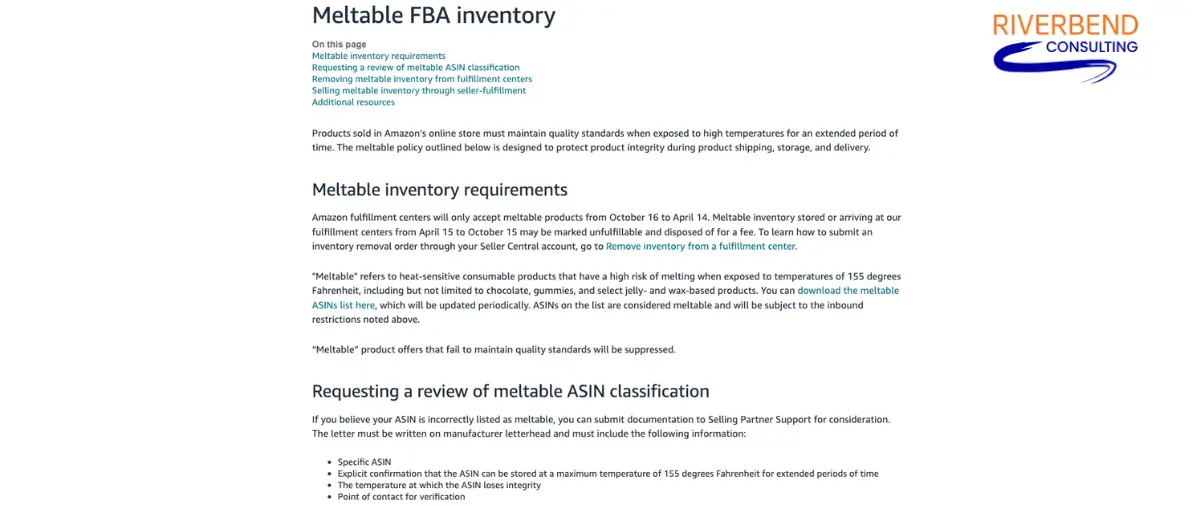
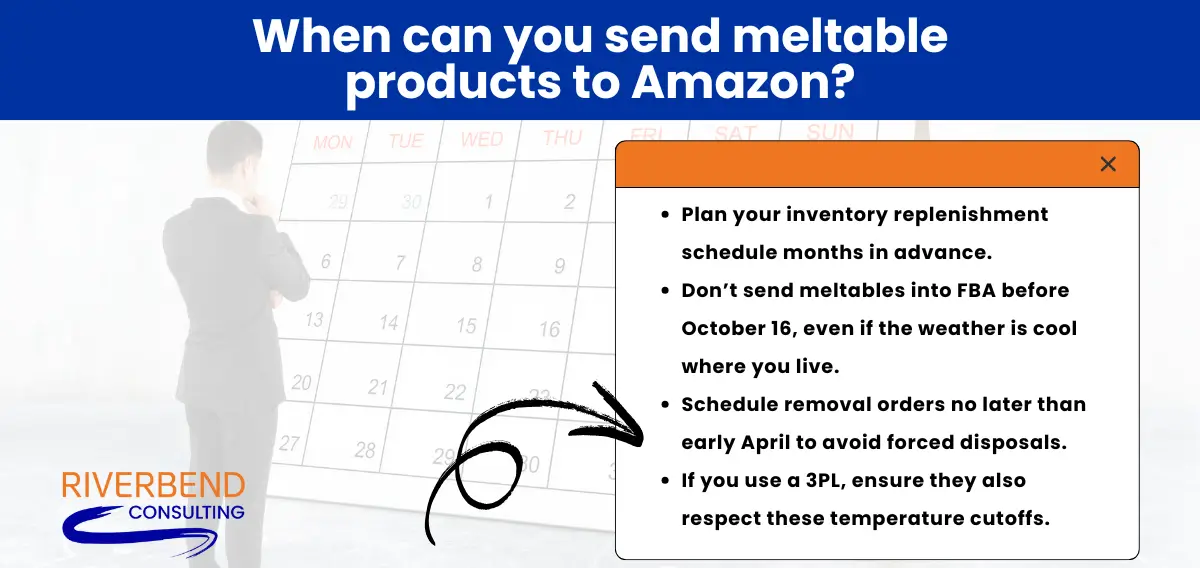
Amazon’s meltable policy is a strict calendar-based rule for all FBA sellers with qualifying products. Every year, Amazon sets a meltable inventory cutoff, typically from April 15 to October 15. No meltable products can be stored or shipped via FBA during this time.
What does that mean for you? You need to remove any meltable inventory before the cutoff date. If you don’t, Amazon may dispose of your products, no refunds, no Amazon account appeals. It’s that serious. Here’s a basic breakdown of the timeline:
- October 16 to April 14: Approved meltables can be shipped into FBA.
- April 15 to October 15: Meltables cannot be stored or fulfilled via FBA.
During the meltable window, your best alternative is merchant fulfillment (FBM), assuming you have climate-controlled storage and can guarantee quality. If you can’t, you may need to pause sales until fall.
The Amazon Meltable Policy ensures customers receive safe, usable products. No one wants to open a package of multivitamins fused into one gelatinous blob. A disappointed customer can lead to a negative review, hurting your conversion rate and buyer trust long after the snow returns.
For Amazon, the policy reduces customer complaints, product returns and fulfillment center messes. Regulating meltables is one of the ways they do that.
For sellers, it creates a level playing field so competitors can’t sneak non-compliant products into FBA and undercut your prices, especially if they ignore the rules. Amazon’s enforcement protects compliant sellers from bad actors and helps maintain consumer trust in your brand.
How to identify if you carry meltable products
You can’t stay compliant with the Amazon Meltable Policy if you don’t realize your product qualifies. Too many sellers assume they’re in the clear unless they sell chocolate bars or gummy bears. That’s a fast way to earn a removal notice, or worse, an Amazon listing violation you didn’t see coming.
Here’s how to stay one step ahead and determine whether your product falls under Amazon’s meltable classification:
Step 1 Check the meltable ASIN list from Amazon: Amazon releases an annual list of ASINs flagged as meltable, typically by March 1. This list is your first line of defense. If you see your product on this list, don’t debate it. Follow the Amazon Meltable Policy period. Review the list as part of your SOPs. Click here to download the list from Amazon Seller Central.
Step 2 Assess the Product’s composition and heat sensitivity: Ask yourself: Would this product hold up in a 100-degree warehouse for a few days? If not, it’s probably meltable. Any product that softens, separates, leaks, or loses quality at temperatures up to 155°F (68.3°C) will be classified as meltable by Amazon standards.
Step 3 Consult the manufacturer’s specs or lab reports: If you’re unsure, don’t guess. Contact your manufacturer or supplier and request documentation on the product’s heat tolerance. Many problems can be avoided simply by getting clear information up front, especially if you’re sourcing products you didn’t formulate yourself.
How to handle and ship meltable products
When it comes to meltables, prep is everything. If your product isn’t packed right, it’s at risk of arriving damaged. Damaged productivity can quickly tank your account health. Here’s what best-in-class prep looks like:
Use insulated packaging during transit: When shipping to Amazon fulfillment centers, especially in warmer months or from warmer climates, insulated liners and ice packs can help reduce exposure to extreme heat.
Choose fast, reliable carriers: Avoid economy ground options for meltables. Go with expedited shipping to minimize time in transit and reduce the risk of temperature damage.
Clearly label your packages:Mark boxes with “PERISHABLE” or “KEEP COOL” where applicable, even if Amazon doesn’t require it, carriers may treat the package with more care.
Use climate-controlled storage before FBA: Store meltables in a regulated temperature and humidity facility. If you’re using a 3PL, ask for documentation showing they meet this standard.
Be conservative with expiration dates: Amazon has strict requirements on shelf life, and temperature-sensitive items can degrade faster. Don’t cut it close. Build in a cushion.
If your meltables require FDA compliance, such as supplements, ensure your packaging is heat-sealed and tamper-proof. Poor prep can lead to damaged product, lost trust and account flags you may never fully recover from.
What compliance documents are required for meltables on Amazon?
Compliance for meltables can vary depending on the product category, but some documentation is non-negotiable, especially when dealing with ingestibles or topicals. Here’s what Amazon might ask for:
- Temperature stability data: Documentation proving your product remains stable at up to 155°F (68°C) for short durations and 77°F (25°C) long term. Many brands get this tested in a third-party lab.
- Safety data sheets (SDS): If your product includes chemicals or pharmaceuticals.
- Certificate of analysis (CoA): For supplements or ingestibles, showing ingredient accuracy and potency.
- Photos of packaging: To demonstrate tamper-resistance and integrity.
- Expiration date proof: To ensure shelf life complies with FBA policy (typically 90 days minimum upon arrival at the fulfillment center).
Be proactive. Don’t wait until Amazon asks; have your documents ready and stored in your account records. If flagged, you’ll have only a few days to respond and delays can mean listings get suspended or inventory gets removed.
What to avoid with the Amazon meltable policy
There are some classic mistakes sellers make with meltables that land them in hot water and many are avoidable. Avoid these pitfalls:
- Ignoring the meltable calendar. Don’t send products during restricted dates, thinking Amazon won’t notice. They will.
- Poor prep or packaging. A little condensation might not seem like a big deal until it triggers a return request. Proper labeling for meltable items is essential.
- Underestimating transit risks. Your product might leave your facility in good shape, but spend 72 hours in a hot delivery truck and it’s game over.
- Listing meltables as non-meltables. You may think Amazon won’t catch it, but they use algorithms and customer feedback to spot patterns. If flagged, you’ll be hit with a performance notification.
- Failing to remove meltables before April 15. Amazon isn’t sentimental. Expired deadline = auto-removal or disposal.
Don’t try to outsmart the system. The safest approach is the most compliant one. Long-term trust with Amazon is more valuable than squeezing out a few extra days of sales.
How to request an exception from the Amazon Meltable Policy
Sometimes Amazon gets it wrong. Maybe your product was misclassified as meltable, even though it holds up in the heat. If that’s the case, you can challenge the meltable status, but you need to come armed with proof, not opinions.
Requesting an exemption from the Amazon Meltable Policyrequires a specific process and airtight documentation. You must come to the table prepared, respectful and ready to follow the chain of command. Here’s how to do it the right way:
Obtain a manufacturer’s letter
You’ll need an official letter on your manufacturer’s letterhead confirming the product’s stability at temperatures up to 155°F (68.3°C). The letter must include:
- The specific ASIN(s) in question
- A clear statement verifying that the product remains stable when stored at temperatures up to 155°F over a prolonged duration
- The specific temperature threshold at which the product begins to degrade, melt, or lose structural integrity
- A reliable contact name, phone number, or email address from the manufacturer, in case Amazon needs to confirm the information directly
Keep it professional and detailed. Vague or incomplete documentation will be rejected or ignored.
Gather supporting evidence
If you have lab reports, temperature testing data, or stability studies, include them. The more proof you provide, the stronger your case. Amazon responds best when you’re thorough and leave no room for doubt.
Submit to seller support
Log in to Amazon Seller Central and open a case with Seller Support. In your message, be brief but specific:
- Identify the ASIN(s)
- Explain why you believe they were misclassified
- Attach the manufacturer’s letter and any additional documents
Follow Up
It may take a few days for Amazon to respond. If you don’t hear back within a week, follow up politely within the same case thread. Avoid opening multiple tickets, as doing so can slow down your request.
Exceptions are granted, but rarely without complete documentation and a businesslike approach. If your product doesn’t melt, make your case with facts, not frustration. And if you’re unsure how to phrase the request or navigate Amazon’s system, Riverbend Consulting can offer Amazon problem solving solutions to help you navigate the exemption.
Best practices to ensure customer satisfaction regarding meltables
When selling temperature-sensitive products, customer satisfaction hinges on timing, transparency and execution. Here’s how to avoid issues and keep your customers happy.
- Inventory management: Stay on top of your inventory calendar. Monitor stock levels so you’re not left with excess meltable goods as the restricted period approaches. Set reminders to submit removal orders wellbefore the cutoff to avoid unexpected disposal fees and inventory losses.
- Product quality: Do regular quality checks, not only when your products arrive, but throughout storage. Packing for meltables means proactively looking for soft packaging, stuck-together gummies, or changes in consistency. And don’t overlook Amazon’s shelf-life rules: if a product arrives at FBA with fewer than 50 days until expiration, it could be removed without warning.
- Customer communication: Use product detail pages, inserts, or post-purchase emails to inform customers that the item is temperature-sensitive. Offer storage tips and set expectations clearly, so if something goes wrong during delivery, your customer knows what to do and who to contact.
By managing meltables like the delicate products they are, you protect your reputation and show your customers that their satisfaction comes first.
Keep cool and stay compliant
Meltable season doesn’t have to be a nightmare. With some foresight and the proper prep, you can protect your products, maintain customer satisfaction and avoid compliance disasters.
The biggest takeaway? Don’t wait. Plan early. Know the policy inside and out. And treat Amazon’s seasonal cutoffs like a hard deadline.
Need help navigating meltable compliance or responding to a performance notification? Riverbend Consulting has helped thousands of sellers protect their accounts and avoid irreversible damage. As always, we’re happy to help.
Seller Account Health. Solved.
FAQs
Q: What products are considered meltable by Amazon?
A: Any item that can degrade, soften, or lose quality at temperatures above 75°F. (Examples include chocolate, gummies, wax-based goods and some beauty products.)
Q: How to ship meltable products with Amazon FBA?
A: Only ship meltables to FBA between October 16 and April 14. Use expedited shipping and insulated packaging to protect products in transit.
Q: How can I stay compliant with the Amazon Meltable Policy?
A: Follow the meltable shipping window, prep items correctly, monitor expiration dates and remove inventory before the restricted period begins.
Q: What happens to meltable inventory during the restricted window?
A: If not removed before April 15, Amazon may dispose of meltable inventory without reimbursement or prior notice.
Q: How should I package meltable items to prevent spoilage?
A: Use sealed, tamper-proof packaging and consider insulation or cold packs for transport. Label shipments clearly when sending to FBA.
Q: Can I still sell meltables after April 15?
A: Not through FBA. You can switch to merchant fulfillment if you have climate-controlled storage and reliable shipping.
Q: What are the temperature requirements for FBA shipments?
A: Meltables must remain stable up to 155°F (68°C) for extended periods to qualify for FBA. Products that fail this may be restricted or removed.