
Artificial Intelligence (AI) is reshaping how Amazon operates, sometimes for better… and sometimes for worse. Most sellers are busy putting out daily fires to stop and think about how AI is changing the rules of the game. But whether we like it or not, the changes are happening and they’re happening fast.
Today, we’ll look at how deeply Amazon is involved in AI, what exactly they’re doing with it, how it’s impacting sellers and most importantly, what you can expect in the future. Because while we can’t slow the pace of change, we can understand it, prepare for it and find ways to thrive in the middle of it.
Is Amazon involved with AI?
Short answer? Absolutely. Longer answer? Amazon has been using forms of artificial intelligence longer than most companies have been talking about it.
Let’s break it down:
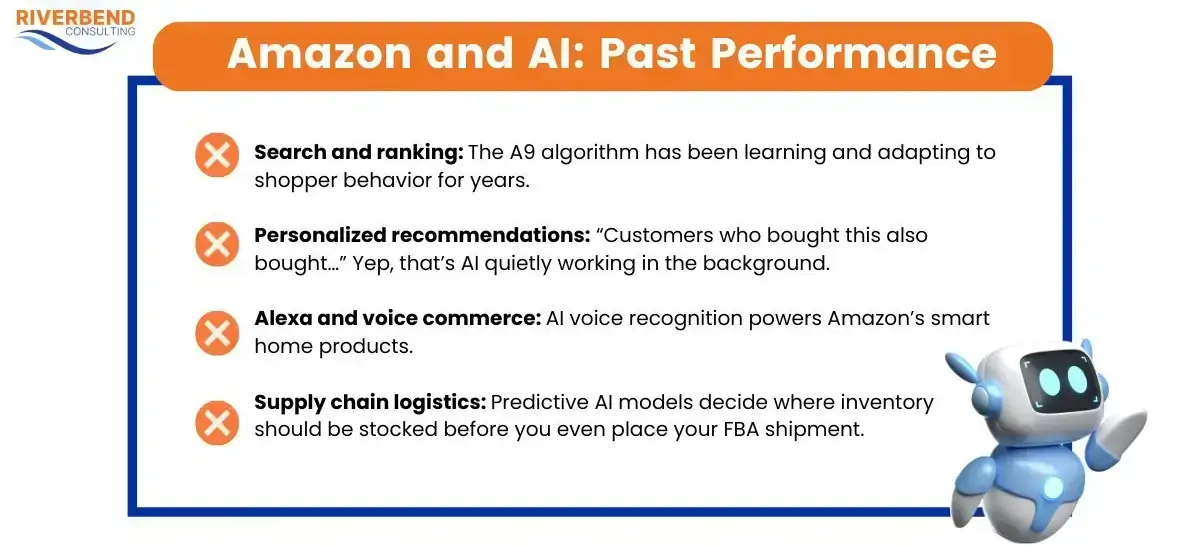
- Search and ranking: The A9 algorithm has been learning and adapting to shopper behavior for years.
- Personalized recommendations: “Customers who bought this also bought…” Yep, that’s AI quietly working in the background.
- Alexa and voice commerce: AI voice recognition powers Amazon’s smart home products.
- Supply chain logistics: Predictive AI models decide where inventory should be stocked before you even place your FBA shipment.
AI is baked into the very fabric of how Amazon moves products, recommends listings and prioritizes businesses.

How is Amazon currently in the AI race?
Amazon is diving headfirst into multiple AI races all at once, each one critical to their dominance across industries. In the tech innovation space, Amazon is competing against heavyweights like Microsoft, Google and Meta, racing to develop foundational AI models such as Titan and Bedrock. These models are designed to position Amazon as a major player in the broader AI economy, offering services that businesses and developers can build upon.
At the same time, Amazon is fine-tuning its personalization engines to recommend the perfect products at the right time, rolling out cashierless Amazon Go stores powered by machine learning and experimenting with AI to optimize pricing and selection on the fly.
Then there’s the logistics race, an area where Amazon’s ambitions have always been bold. Through robotics, predictive analytics and warehouse automation, Amazon is striving to fulfill, ship and deliver faster than competitors like Walmart or Shopify could ever dream. Their vision is clear: make the supply chain so efficient that waiting for a package becomes almost a thing of the past.
Amazon isn’t dipping a toe into AI; they’re cannonballing into it. They’re trying to reshape the future of e-commerce.
AI impact on Amazon sellers
If it feels like Amazon’s everywhere all at once with AI these days, you’re not imagining it. From listings to logistics, Amazon is using AI to make its marketplace smarter, faster and more automated.
But automation is a double-edged sword. Some of these innovations can help you save time and boost efficiency. Others strip away control, introduce new risks and make the marketplace more complex to navigate.
Here’s a closer look at some of the most significant AI initiatives Amazon is rolling out right now and what they could mean for your business.
1. AI Listing Generators
One of the most noticeable AI shifts is the introduction of listing generators. Amazon is testing tools that automatically create product detail pages, including the Amazon title, bullet points and description, based on a few inputs, such as uploading a product image or entering minimal product details.
The upside: These tools can save time, especially for new sellers or those managing extensive catalogs. Instead of struggling to craft every word, you can lean on AI to build a decent starting point.
The downside: AI-generated listings often sound robotic, lack emotional resonance, and fail to capture the brand’s voice. Worse, they can introduce subtle errors that hurt SEO or compliance without you noticing. Branding, the kind that builds customer loyalty, can easily get lost in the shuffle if you rely solely on these tools without careful human editing.
2. Automated Pricing Tools
Pricing is one of the trickiest levers to pull on Amazon and AI is stepping in to “help.” Amazon’s automated pricing tools monitor marketplace dynamics and either suggest or automatically change your product prices in real time.
The upside: You can stay competitive without babysitting your listings. Automated tools can respond faster to price changes from competitors, helping protect Buy Box placement and maximizing your chances of a sale.
The downside: Pricing algorithms prioritize sales volume over profitability. AI can push prices dangerously low, eroding your margins or, even worse, sparking price wars that hurt entire categories. If you aren’t watching closely, they could find themselves moving more units but making less money.
3. Predictive Inventory Systems
Managing FBA inventory has never been simple, but Amazon’s machine learning models are trying to make it more “intelligent.” Predictive inventory systems forecast where demand will be highest and pre-position products at fulfillment centers accordingly.
The upside: When AI works well, customers receive faster deliveries and your products are more likely to display Prime-eligible badges, a major benefit.
The downside: You can lose control over where inventory goes, how it’s split across warehouses and sometimes face unexpected long-term storage fees. Amazon’s forecasting isn’t perfect and when their guess is wrong, you may bear the financial consequences.
4. Ad Campaign Automation
If you’ve been running Sponsored Products, Sponsored Brands, or Sponsored Display ads lately, you might have noticed Amazon’s increasing push toward AI-automated campaigns. These systems are designed to optimize bids, placements and targeting based on customer behavior, with less manual input.
The upside: If you find PPC overwhelming or time-consuming, AI automation can deliver solid results without needing a marketing degree to run ads effectively.
The downside: You may lose visibility and control. It becomes harder to understand why specific keywords or audiences are targeted and where ad dollars are spent. Fine-tuning campaigns based on strategy, not just spend, gets trickier when AI is making decisions behind the curtain.
5. Project Amelia
Project Amelia represents Amazon’s deeper dive into “end-to-end” AI solutions, particularly private label brands. The idea is simple: simplify the process of launching and optimizing listings, offering automated keyword research, listing creation and campaign management.
The upside: For new sellers or small brands without a budget for expert help, Amelia can lower the barrier to entry.
The downside: Early feedback suggests that Amelia-generated content often lacks the polish, depth, and brand voice needed to stand out. Relying too heavily on it could lead to “vanilla” listings that fail to connect with customers emotionally, or worse, listings that aren’t differentiated from competitors.
Amazon’s AI bottom line is clear: automation and efficiency at scale. And for you as a seller, that can mean more tools, more shortcuts and more ways to succeed or stumble.
Staying informed, auditing your listings, repricing regularly and layering human creativity on top of AI automation can give you the best shot at thriving in this new era. Those who go hands-off and assume AI will “just work” in their favor might find themselves sidelined faster than they realize.
How is Amazon and AI helping and hurting your Amazon business?
It would be easy to paint AI as either the hero or the villain of the Amazon marketplace, but the truth lives somewhere in the messy middle.
Artificial intelligence is opening up exciting new doors, but it’s also quietly creating new risks that didn’t exist a few years ago. Whether AI helps or hurts your business isn’t about the technology itself; it’s about how you interact with it, manage it and sometimes, push back against it.
On the positive side, AI has made certain tasks faster and more efficient. Creating listings, adjusting ad campaigns and forecasting inventory can now happen in minutes with the right tools.
For sellers managing extensive catalogs or operating with small teams, this kind of automation is a serious competitive advantage. AI surfaces insights that might have gone unnoticed otherwise, revealing new keyword opportunities, emerging customer trends and more innovative cross-sell strategies that can help grow your business when used thoughtfully.
The darker side of Amazon and AI can mean a loss of control. When Amazon’s AI automatically rewrites a listing, adjusts a price, or changes ad targets, these changes may not align with your brand strategy or financial goals. You may find that your brand voice is diluted and flattened into generic AI copy, erasing the emotional connection you’ve built with your audience.
Perhaps most concerning, AI has introduced a level of opacity into Amazon’s decision-making that’s difficult to challenge. Listing suppressions, account flags and policy enforcement can now happen faster than ever, but not necessarily fairly. If an AI model flags a product incorrectly or misreads customer behavior, it can lead to sudden Amazon account suspensions or suppressed ASINs, often with limited human recourse for appeals. You may find yourself forced to navigate automated decisions with limited visibility into the “why,” and that can be frustrating, stressful and sometimes costly.
Amazon and AI are not purely good or purely evil. AI is a powerful tool that can either empower or undermine a business, depending on how it is handled.
Amazon AI seller competition and what to do about it
Thanks to AI-driven listing tools, auto-generated content and algorithmic pricing, it’s easier than ever for new sellers to flood the marketplace with products. Tools that used to require expertise are now one click away for anyone willing to upload a SKU and press “optimize.”
The result? Competition is multiplying rapidly. And not all competition is high quality. Many AI-assisted listings are shallow, repetitive and built purely to game the system rather than serve the customer. But when quantity increases, low-quality listings can clog search results, drive prices down and make it harder for legitimate sellers to stand out.
So what can you do about it?
- Stay authentic: AI can copy keywords, but it can’t replicate your story or mission. Keep a strong human voice across your listings, storefront, and brand messaging.
- Go deeper than basic SEO: Many AI listings hit keywords but miss the emotional connection. Focus your content on real customer needs, not just algorithm triggers.
- Defend your brand: Use Brand Registry, monitor your listings and protect your brand assets. With AI flooding the marketplace, having safeguards in place is essential.
- Stay agile: Keep testing, refining, and adjusting. AI moves fast, but sellers who stay flexible and strategic will have an edge.
You’re no longer just competing with other sellers; you’re competing with automation. What sets you apart is simple: real connection, real creativity, and real trust — the things AI can’t fake and customers won’t forget.
What to expect with Amazon and AI in the future

If there’s one thing you can count on, it’s that Amazon isn’t going to slow down its AI ambitions, not now, and not anytime soon. The pace of change is likely to speed up, not settle down. Looking ahead, you should prepare for fundamental shifts that will reshape how we do business on Amazon.
First, we can expect to see a continued surge of AI-generated content across the marketplace. From product listings to customer service responses, Amazon will continue to lean on automation to standardize experiences and lower its operational costs. This means you may have to work harder to maintain authenticity and emotional connection in your branding. Cookie-cutter listings won’t cut it when buyers are flooded with generic product pages.
Second, pricing pressure may intensify. AI-powered dynamic pricing models are already active, but they may become more aggressive. Price changes can occur minute by minute based on competitor behavior, customer demand, or broader market conditions. If you haven’t built a unique value proposition beyond a low price, you may find yourself squeezed harder than ever.
Third, fraud detection and account enforcement may become more AI-driven and that’s a double-edged sword. On the positive side, AI can help weed out bad actors faster, making the marketplace safer for legitimate sellers. However, because these systems operate on algorithms, not context, good sellers may sometimes get caught in the crossfire. A sudden account suspension or ASIN suspension may come from a bot’s misunderstanding, not actual wrongdoing. Navigating these challenges may require you to be diligent about compliance, documentation and closely monitoring your account health.
Fourth, the rise of third-party AI tools will create both opportunities and confusion. You may be bombarded with promises of AI-driven keyword research platforms, inventory management systems, review monitoring bots and more. Some of these tools will offer real competitive advantages; others will create noise. Careful vetting, clear goal setting and a focus on tools that enhance, not replace, strategic decision-making will be critical.
Finally, expect Amazon to double down on hyper-personalized customer experiences. Amazon AI models will continue to refine product recommendations, search results and ad targets, tailoring to individual shopping behaviors. Align yourself with this new reality by building a strong brand reputation to show up more often and convert more customers.
Where do you go from here?
You’re already operating in an AI-driven Amazon world, whether you asked for it or not. And while it’s tempting to feel overwhelmed by all the change, you have more power than you think.
You don’t have to outdo Amazon and AI. You need to stay connected to what made you a strong seller in the first place: knowing your customers, understanding your products and making smart, thoughtful moves instead of reactive ones.
AI might speed things up, but it can’t replace your instincts. It can’t see the way you do when a listing needs a little more heart, or when a product deserves a better story. It can’t build relationships. It can’t create loyalty. Only you can do that. Moving forward, it’s not about fighting AI. It’s about using it when it makes sense and trusting yourself enough to know when to take the reins back.
If AI errors or sudden policy shifts have put your Amazon account at risk, it’s critical to act quickly and carefully. Get expert Amazon account reinstatement help to build the strongest possible case and protect your selling future.
Seller Account Health. Solved.
Frequently Asked Questions
#1 How does Amazon’s AI give some sellers an advantage?
Amazon’s AI rewards sellers who hit performance benchmarks like fast shipping and high conversions. These sellers gain better visibility, more Buy Box wins and stronger placement in search results.
#2 Can Amazon sellers opt out of AI-driven decisions?
No. Amazon’s systems are built on machine learning. While sellers can skip optional tools like dynamic repricing, all accounts are still impacted by AI-based evaluations.
#3 Does Amazon’s AI make it harder for new sellers to compete?
Yes, it can. Without a track record, new sellers are less likely to earn visibility or Buy Box placement until they prove performance consistency.
#4 What are the biggest complaints sellers have about Amazon’s AI?
Sellers often cite a lack of transparency and sudden enforcement actions. Misclassifications, automated suspensions and vague metrics top the list of frustrations.
#5 How can Amazon sellers fight back against AI bias?
Document everything, monitor metrics closely, nd be ready with strong, policy-based appeals. A solid Plan of Action can often reverse AI-triggered enforcement.
#6 Are Amazon’s AI tools worth the cost for small businesses?
Sometimes. They can boost efficiency, but without careful oversight, they can also drain profits or push prices too low.
#7 Does Amazon’s AI favor big brands over independent sellers?
Often, yes. Big brands benefit from stronger data signals like high volume and trust, which the algorithm rewards.
#8 How do Amazon’s AI pricing bots hurt seller profits?
Repricing bots can trigger price wars that erode margins. Sellers who don’t set firm pricing rules risk racing to the bottom.